
Keyword Density: The Sweet Spot and the Myths
What keyword density actually does in modern SEO, the realistic 0.5–2% range, why phrase analysis beats word counts, and the editing workflow that fixes stuffing.

Keyword density is the most misunderstood number in SEO. One camp still believes there is a magic percentage that unlocks rankings. Another insists density is dead and you should never count keywords at all. Both are wrong — and the truth is more useful than either myth.
Google does not rank pages by keyword percentage. But keyword frequency and placement still shape how clearly a page communicates its topic — and stuffing still triggers penalties. Density is a diagnostic: a quick X-ray that shows whether your draft says what you think it says. This guide covers what density actually does, the realistic sweet spot, why phrase-level analysis beats single words, the best checkers, and how to fix a keyword-stuffed page.
Keyword Density Checker
Check how often a term appears before you publish.
What keyword density is (and what Google does with it)
Density = keyword occurrences ÷ total words × 100. Five uses of “keyword density checker” in a 500-word post = 1% density.
Early search engines leaned heavily on this number, which spawned an era of pages reading like “best cheap hosting best cheap hosting deals for best cheap hosting”. Google’s response — from the Florida update through Panda and today’s language models — was to get very good at recognising both topical relevance and unnatural repetition. Modern reality:
- Zero mentions of your target phrase makes ranking for it genuinely harder — Google still reads words.
- Natural, moderate usage plus synonyms and related terms is what strong pages look like statistically.
- Aggressive repetition is a spam signal that can suppress the whole page. Google’s spam policies name keyword stuffing explicitly.
The realistic sweet spot
Most experienced SEOs converge on 0.5%–2% for a primary keyword — not because Google publishes a threshold, but because that is the range natural expert writing lands in. Below 0.5%, check that your page actually addresses the phrase; above 2–3%, read it aloud — it almost certainly sounds robotic.
Placement outweighs raw count: the title, URL, first 100 words, at least one H2, and image alt text carry more signal than a fifth repetition in paragraph nine. Cover the topic — related entities, synonyms, the questions searchers ask — and healthy density happens by itself. (Find those related phrases with our keyword research tool.)
Why phrase analysis beats single-word counts
Nobody searches “checker”. They search “keyword density checker”. Analysing 2-word and 3-word phrases shows you which actual queries your page is optimised for — and surfaces accidental repetition (“in order to” 14 times) that single-word counts hide. A good checker treats phrases as first-class citizens; it is the difference between diagnosing your page and admiring a word cloud.
The best keyword density checkers compared
1. HN Solutions Keyword Density Checker — best free, private analysis
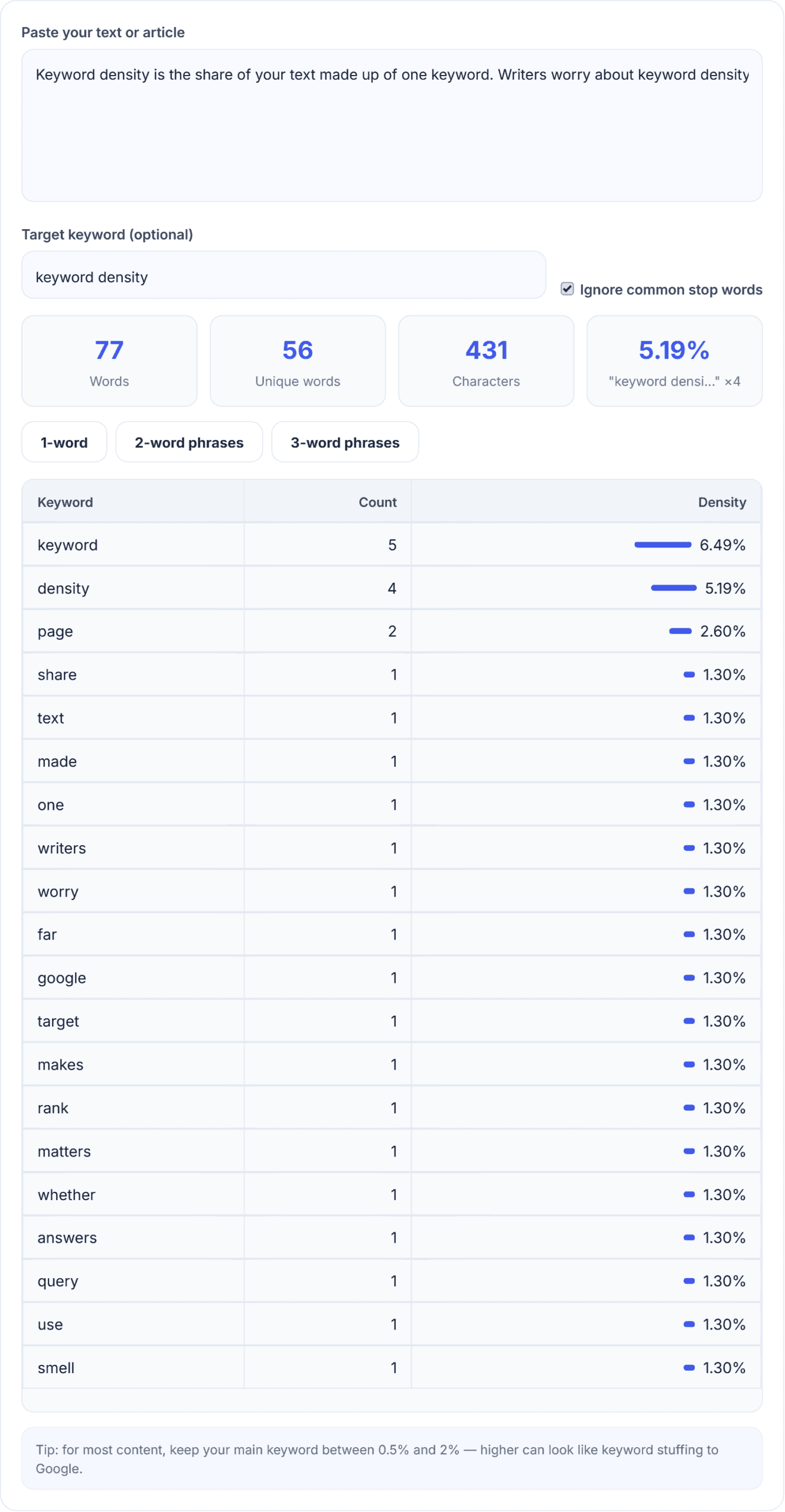
Our keyword density checker analyses 1, 2 and 3-word phrases live as you paste, with counts, percentages and visual bars. Set a target keyword and its exact count and density pin to the top. A stop-word filter strips “the/and/of” noise so real keywords surface. Everything runs in your browser — unpublished drafts and client work never touch a server. Free, unlimited, no sign-up.
2. SmallSEOTools density checker — works, with friction
Handles URLs as input, but expect ads, captchas and a server-side process for your text.
3. SEO Review Tools — clean single-purpose checker
Decent free option with URL fetch; limited phrase depth and no live-as-you-type analysis.
4. Yoast / Rank Math built-ins — good inside WordPress
Both flag keyphrase usage in the editor (you already have Rank Math-style checks if you run WordPress). They check presence and rough distribution rather than full phrase tables — pair them with a standalone checker for the complete picture.
5. Surfer / Clearscope — paid content optimisation
These go beyond density into full statistical content scoring against the SERP. Excellent, and priced for teams.
Why choose our checker
- Phrase-first: 2 and 3-word tables show real queries, not word confetti.
- Target tracking: your focus keyword’s density sits in a dedicated stat — no hunting through tables.
- Stop-word intelligence: filler words filtered by default so the signal is instant.
- Private: client-side analysis means embargoed and confidential text stays yours.
- Live: edit your draft and watch density change in real time — perfect for the final polish pass.
How to use the density checker (the editing workflow)
- Finish your draft first. Write for humans; optimise after.
- Paste it into the keyword density checker and enter your target keyword.
- Check the target density stat: under 0.5% → look for natural spots to state the topic plainly (intro, one H2, conclusion). Over 2.5% → replace repetitions with synonyms or pronouns.
- Scan the 2–3 word tables for surprises: filler phrases repeating, or a secondary phrase outranking your target — sometimes that is a better keyword to lean into.
- Edit, re-paste, confirm. Then set the title and description with the meta tag generator.
Pro tips: aim your exact phrase at the title, first paragraph and one heading, then let variants carry the rest; check competitors — paste a top-ranking rival’s text in and see what balance they strike; and never sacrifice a good sentence for a keyword. Ever.
Keyword density questions
What density gets you penalised?
There is no published number — the penalty is for unnatural usage. Pages reading normally at 3% exist; pages reading like spam at 2% exist too. The read-aloud test beats any threshold.
Do headings count toward density?
Yes, all visible text counts — and keywords in headings carry extra weight, so they are efficient placements.
Should I count stop words?
Filter them for analysis (our default) — “the” at 6% is meaningless. Include them only when auditing exact-match phrases that contain them.
Does density matter for AI search results?
AI Overviews reward clear, well-structured topical coverage — the same qualities healthy density reflects. Stuffing hurts you there just as much.
Stop counting, start reading
Treat keyword density like a smoke detector, not a steering wheel: it will not drive rankings, but it warns you when something is off. Run every important draft through the free density checker, feed it keywords from the research tool, and finish with the meta tag generator — the full stack is in our free SEO tools hub.