Sony WH-1000XM6 vs WH-1000XM5: Is the Upgrade Worth It?
A specification-by-specification comparison built from Sony's own data — what genuinely changed, what stayed identical, and the one number that went down.

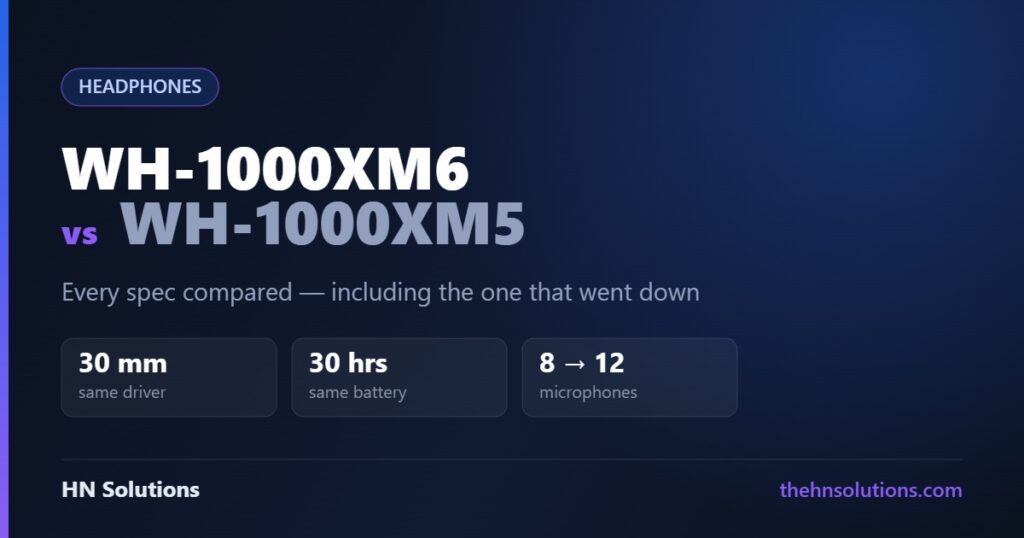
Sony’s flagship noise-cancelling headphones came out in a new version three years after the last one, and the marketing around any generational jump makes it sound like everything improved. Put the two specification sheets side by side and a more useful picture appears: a handful of real changes, a long list of things that are identical, and one number that actually went down.
This is a research-based comparison built from Sony’s own published specifications for both models, not a hands-on test. Where the two sheets disagree with the marketing, we go with the sheets. Read our review standards.
The short answer
Buy the XM6 if you need it to fold, or you take calls for a living. Those are the two changes that genuinely alter the product — the hinge is back, and the microphone count went from 8 to 12 with a dedicated six-mic beamforming array for voice.
Buy the XM5 if neither of those applies. Same 30 mm driver, same 30-hour battery, same frequency response, same impedance, and a measured sensitivity difference of one decibel. You are paying the newer-model premium for a hinge and a microphone array.
What actually changed
Five things, in rough order of how much they will affect your day.
1. The folding hinge came back
The XM5 dropped the folding design that every previous model had. The case grew, and a product built for travel got worse at travelling. It was the most complained-about change in the range’s history.
The XM6 folds again, using a metal-injection-moulded hinge, and the case shrank accordingly and swapped its zip for a magnetic closure. If you have spent three years irritated by the XM5’s case every time you packed a bag, that is the upgrade — not the audio.
2. Twelve microphones instead of eight
Sony’s own figure is that the XM6 has “12 microphones, which is 1.5 times more than its precursor the WH-1000XM5.” That puts the XM5 at 8, which matches its published specification.
Those mics are driven by a new HD Noise Cancelling Processor QN3, which Sony rates at seven times the processing speed of the XM5’s arrangement — that model used a QN1 alongside a separate Integrated Processor V1.
3. Calls got a dedicated microphone array
This is the change most likely to matter if you work remotely. The XM6 adds a six-microphone AI beamforming system specifically for voice pickup, plus a mic-mute button on the headphone itself. Call quality was the one area where the XM5 was routinely marked down against Bose and against dedicated headsets.
4. LE Audio, Auracast and Bluetooth 5.3
The XM5 runs Bluetooth 5.2 with SBC, AAC and LDAC. The XM6 runs 5.3 and adds the LC3 codec, plus the whole LE Audio profile stack — TMAP, CSIP, MCP, VCP, CCP, PBP and GMAP — which is what makes Auracast possible.
Be realistic about this one. Auracast lets you tune into public audio broadcasts at airports, gyms and cinemas. The venues have to support it, and in 2026 most do not. It is a reason to prefer the XM6 if you are keeping headphones for five years, not a reason to upgrade today.
5. The app got twice the EQ
Five bands on the XM5, ten on the XM6, along with a Game EQ profile borrowed from Sony’s INZONE range and a cinema upmix mode. Minor, but the equaliser is the single most underused feature on these headphones, and more bands means more of the tuning is fixable if you do not like Sony’s house sound.
The full specification comparison
Figures below are Sony’s own, from the published specification pages for each model. Rows shaded blue are genuine differences. The amber row is the one that moved backwards.
| Specification | WH-1000XM5 | WH-1000XM6 |
|---|---|---|
| Released | May 2022 | May 2025 |
| Driver unit | 30 mm | 30 mm |
| Weight | 250 g | 254 g |
| Processor | QN1 + Integrated V1 | QN3 (7× faster) |
| Microphones | 8 | 12 |
| Call microphones | Not specified | 6-mic AI beamforming |
| Battery, music, ANC on | 30 hrs | 30 hrs |
| Battery, music, ANC off | 40 hrs | 40 hrs |
| Battery, calls, ANC on | 24 hrs | 24 hrs |
| Battery, calls, ANC off | 32 hrs | 28 hrs |
| Charge time | ~3.5 hrs | ~3.5 hrs |
| Quick charge | 3 min → 3 hrs | 3 min → 3 hrs |
| Bluetooth | 5.2 | 5.3 |
| Codecs | SBC, AAC, LDAC | SBC, AAC, LDAC, LC3 |
| LE Audio / Auracast | No | Yes |
| NC optimiser | Auto NC Optimizer | Adaptive NC Optimizer |
| Atmospheric pressure optimising | Yes | Yes |
| Sensitivity (wired, powered) | 102 dB/mW | 103 dB/mW |
| Impedance (powered / off) | 48 Ω / 16 Ω | 48 Ω / 16 Ω |
| Frequency response | 4 Hz – 40 kHz | 4 Hz – 40 kHz |
| Passive wired operation | Yes | Yes |
| Folds | No | Yes |
| Case closure | Zip | Magnetic |
| App EQ bands | 5 | 10 |
| Listen while charging | No | Yes |
The number that went down
Sony rates talk time with noise cancelling switched off at 32 hours on the XM5 and 28 hours on the XM6. Four hours fewer, on the model being sold as the one that fixed calls.
We have not seen Sony explain the change. The likely cause is the extra microphones and the LE Audio radio drawing more power, but that is inference, not a sourced fact, and we are not going to present it as one.
What did not change, despite sounding like it did
This is the part comparison articles usually skip, and it is the part that should decide your purchase.
The driver is the same size. Both models use a 30 mm unit. Sony redesigned the diaphragm with a carbon-fibre composite dome and a new voice coil structure, so the driver is not identical — but anyone telling you the XM6 has a bigger driver is wrong, and a redesigned 30 mm driver is a refinement rather than a new class of hardware.
Battery for music is identical. 30 hours with ANC on, 40 with it off, on both. Same 3.5-hour charge time, same three-minutes-for-three-hours quick charge. If you have read that the XM6 has significantly longer battery life, that claim does not come from Sony.
The measurable audio specs barely move. Same frequency response, 4 Hz to 40 kHz. Same impedance. Sensitivity rises by exactly one decibel. Whatever difference you hear between these two headphones is voicing and processing, not a hardware leap — which is also why the difference is a matter of preference rather than of better and worse.
Comfort, and one detail that could decide it for you
The XM6 gets a wider headband with vegan-leather padding and an asymmetrical shape so you can tell left from right at a glance. Both changes are aimed at long-wear comfort, and reviewers generally agree they work.
But the earcups on the XM6 are slightly smaller than the XM5’s. If you have larger ears, or you already find the XM5 a close fit, that is a reason to look carefully before upgrading — a smaller cup on a head it does not suit will cost you more comfort than a wider headband gains you, and it will cost you noise cancellation too, because cancellation depends on the seal.
The same applies to glasses. Arms break the seal on any over-ear headphone, and no amount of processing fixes a gap. This is physics rather than a Sony problem, but it means lab measurements will always beat what you get.
Which one should you buy?
If you travel or take calls
- You pack them regularly and the case size has annoyed you
- You are on video calls most of the working day
- You want to keep one pair for five years and would rather have LE Audio than not
- You use the equaliser and want the extra bands
- You want to keep listening while it charges
If you mostly listen
- Your headphones live on a desk or in one bag and rarely get packed
- Calls are occasional rather than constant
- You have larger ears or already find the fit snug
- You would rather put the difference toward something else
- You already own them — there is no audio reason to replace a working pair
What this comparison cannot tell you
Specifications describe hardware. They do not describe listening, and it would be dishonest to pretend otherwise.
We have not measured noise cancellation in a lab, compared them on an aircraft, or worn either for eight hours. Sony’s claim that the XM6 has the best noise cancelling available is its own measurement, conducted against the top ten brands by market share using IEC-compliant guidelines, dated 1 March 2025. That is a manufacturer testing its own product — worth reading as a directional claim rather than an independent result.
For measured cancellation curves and frequency response plots, go to people with the equipment: RTINGS and SoundGuys both publish theirs. What this article gives you is the specification comparison done carefully, with the identical rows left in rather than quietly dropped.
Frequently asked questions
Is the XM6 worth it over the XM5?
Only for the folding hinge or the call microphones. The driver size, battery life, frequency response and impedance are identical, and sensitivity differs by one decibel. If you fly often or live on calls, yes. If you mostly listen to music at a desk, the XM5 gives you the same listening experience for less.
Does the XM6 have better battery life than the XM5?
No. Both are rated at 30 hours of music with noise cancelling on and 40 hours with it off, with the same 3.5-hour charge time. Talk time with ANC off is actually lower on the XM6 — 28 hours against the XM5’s 32.
Does the XM6 have a bigger driver?
No. Both use a 30 mm driver. Sony redesigned the diaphragm and voice coil for the XM6, but the size is unchanged. Any source telling you the XM6 moved to a larger driver is mistaken.
Do the XM5 fold?
No. The XM5 removed the folding hinge that earlier models had, which is why its case is larger. The XM6 brings folding back and uses a more compact case with a magnetic closure.
What is Auracast and do I need it?
Auracast lets a venue broadcast audio directly to compatible headphones — airport announcements, gym screens, cinema soundtracks. The XM6 supports it through LE Audio; the XM5 does not. Very few venues have deployed it so far, so treat it as future-proofing rather than a feature you will use this year.
Can both work wired if the battery dies?
Yes. Both list passive operation and ship with a 3.5 mm cable, so they keep working as ordinary wired headphones with no power. Noise cancellation and app features need battery, but you will not be left in silence.
Which is better for an open-plan office?
The XM6, marginally, because of the extra microphones. But be realistic about what cancellation does: it removes steady low-frequency sound like air conditioning and server hum extremely well, and it does very little about the conversation behind you. For voices, the answer is cancellation plus something playing — on either model.
- Sony WH-1000XM6 review — the full write-up
- Sony WH-1000XM5 review — the model it replaces
- Bose QuietComfort Ultra Earbuds — the in-ear version of this decision
- Audio-Technica ATH-M50x — what you get if you skip cancellation entirely
- Jabra Evolve2 75 — if calls are genuinely the whole job
Sources. All specification figures are taken from Sony’s published specification pages for the WH-1000XM6 and WH-1000XM5, and from Sony’s WH-1000XM6 press release of 15 May 2025. We have not tested either product and do not claim to have.