What Is Agentic AI? The Clearest Explanation You’ll Find in 2026

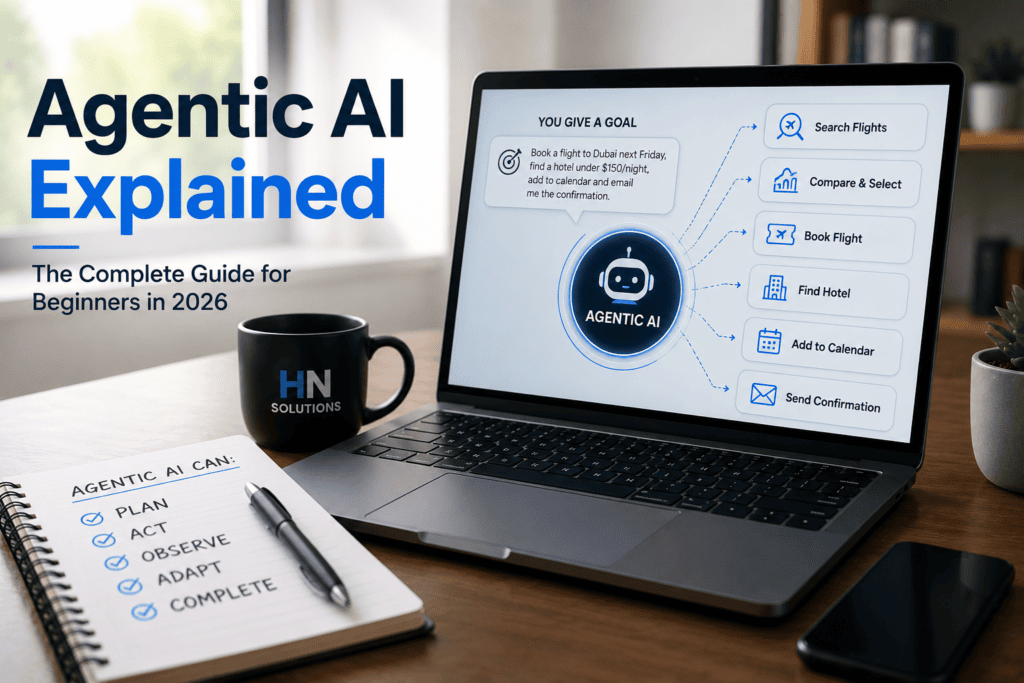
“Agentic AI” is everywhere in 2026 in tech headlines, job postings, investor reports, and casual conversations. But most explanations either drown you in technical jargon or stay so vague they tell you nothing. This guide is different. By the end, you’ll understand exactly what agentic AI is, how it differs from the AI you already use, why it matters, and what it means for your work and life in plain English.
Table of Contents
Start Here: The Simplest Possible Explanation
Imagine you hire an assistant and give them one instruction:
“Book me a flight to Dubai next Friday, find a hotel near the business district under $150/night, add both to my calendar, and email me the confirmation.”
A traditional assistant (or traditional AI) would say: “Got it. Here’s some information about flights to Dubai.” Then you’d have to take that information and do the actual booking yourself.
An agentic AI would actually do it. It would:
- Search for available flights on Friday
- Compare prices and options
- Select the best one based on your preferences
- Book it
- Search for hotels near the business district
- Filter by price
- Book one
- Add both to your calendar
- Send you a confirmation email
All of this autonomously, in sequence, without you doing anything between steps.
That’s agentic AI in one sentence: AI that doesn’t just answer questions — it takes actions to complete goals.
The Technical-Free Definition
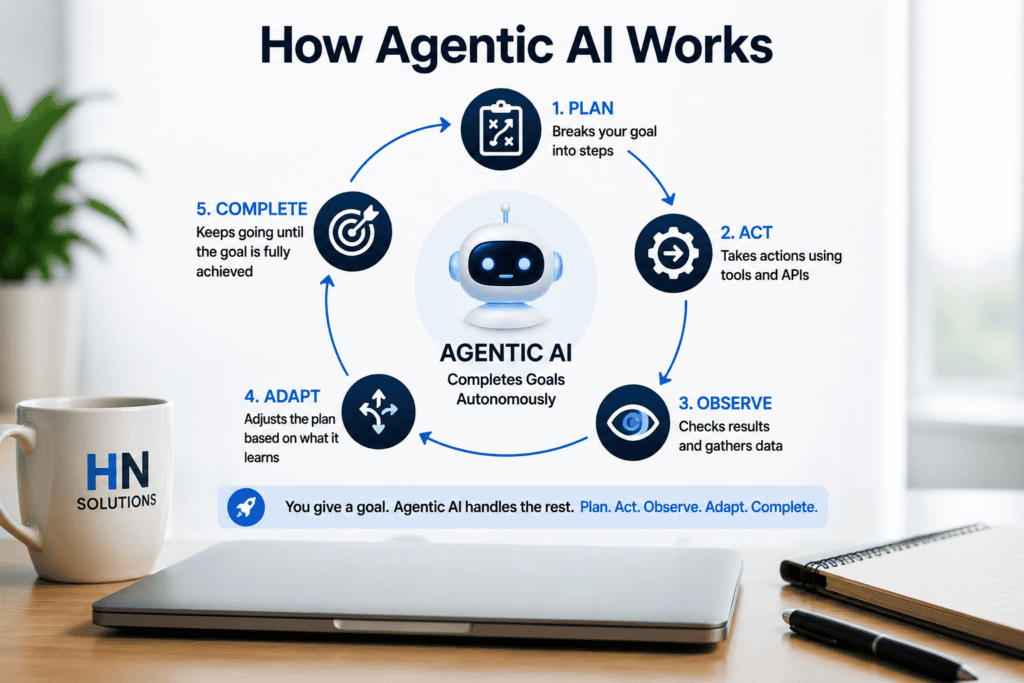
Agentic AI (also called AI agents) refers to artificial intelligence systems that can:
- Plan — Break a complex goal into a series of steps
- Act — Take real actions in the world (browse websites, write files, send emails, run code)
- Observe — Check the results of each action
- Adapt — Adjust the plan based on what they find
- Complete — Keep going until the goal is achieved
The word “agentic” comes from “agency” the capacity to act independently in the world. Agentic AI has agency. It doesn’t wait for you to direct every step. You give it a goal and it figures out how to get there.
Standard AI vs Agentic AI: The Key Difference
This distinction is the most important thing to understand and most explanations get it wrong by making it seem more complicated than it is.
Standard AI (What Most People Use Today)
You → Ask question → AI → Answers → You act on it
Standard AI is reactive. It responds to what you give it. Every action still requires a human in the loop.
Example: You ask Claude “What are the best SEO strategies for a new blog?” Claude gives you an excellent answer. Then you go implement those strategies yourself.
Claude answered. You acted.
Agentic AI
You → Give goal → AI → Plans + Acts + Observes + Adapts → Delivers result
Agentic AI is proactive. It takes sequences of actions autonomously to complete a goal.
Example: You tell an AI agent “Audit my blog’s SEO, identify the top 5 issues, and create a prioritized fix list with specific instructions for each.” The agent:
- Crawls your website
- Analyzes page speeds
- Checks meta titles and descriptions
- Reviews internal linking structure
- Assesses content quality
- Identifies the top 5 issues
- Researches fix instructions for each
- Delivers a formatted, prioritized report
You gave the goal. The agent acted.
What Makes an AI Agent Actually Work?
Three things combine to make agentic AI possible:
1. Tool Use
AI agents can use tools software capabilities that let them take actions beyond generating text. Common tools include:
- Web browsing — searching and reading websites
- Code execution — writing and running actual code
- File management — reading, creating, and editing files
- API connections — interacting with external services (Gmail, calendar, databases)
- Form filling — completing actions on websites
Without tools, an AI can only generate text responses. With tools, it can interact with the digital world.
2. Memory
Agents need to remember what they’ve done and what they’ve found as they work through a multi-step task. Without memory, an agent would forget step 1 by the time it reaches step 5.
3. Planning
The ability to break a complex goal into a sequence of logical steps and to revise that plan when something unexpected happens. This is what separates an agent from a simple automation script.
Real-World Examples of Agentic AI in 2026
Abstract concepts become clear through concrete examples. Here’s what agentic AI actually looks like in practice:
Example 1: Research and Content Creation
Goal given to agent: “Research the top 5 trends in affiliate marketing in 2026, find 3 credible sources for each trend, and write a 1,500-word blog post summarizing the findings.”
What the agent does:
- Searches the web for affiliate marketing trends
- Reads multiple industry articles and reports
- Identifies the 5 most consistently mentioned trends
- Finds and verifies 3 credible sources per trend
- Writes a structured 1,500-word article
- Delivers the completed draft
What you do: Review and publish.
Example 2: Email Management
Goal given to agent: “Go through my emails from the last week. Summarize the ones that need responses, draft replies for routine inquiries, flag urgent ones, and unsubscribe me from newsletters I haven’t opened in 3 months.”
What the agent does:
- Reads through a week of emails
- Categorizes each one
- Drafts responses for routine matters
- Flags urgent items with brief summaries
- Identifies unopened newsletters
- Processes unsubscription requests
What you do: Review flagged emails and approve drafted replies.
Example 3: Competitor Analysis
Goal given to agent: “Find the top 10 blogs in the ‘make money online’ niche, analyze their top-performing articles, identify content gaps they haven’t covered, and give me 20 article ideas that would fill those gaps.”
What the agent does:
- Searches for leading blogs in the niche
- Analyzes their most-trafficked content
- Identifies missing topics across all 10 blogs
- Generates 20 specific article ideas with rationale
What you do: Pick the best ideas and start writing.
Example 4: Customer Service Automation
Goal given to agent: “Monitor our support inbox. Answer common questions automatically using our FAQ database. Escalate anything complex or emotional to a human. Send follow-up satisfaction surveys 24 hours after each resolved ticket.”
What the agent does:
- Monitors incoming support messages continuously
- Matches questions against FAQ database
- Responds automatically to routine inquiries
- Flags complex cases for human review
- Sends scheduled follow-up surveys
What you do: Handle escalated cases only.
The Spectrum of Agentic AI
Not all AI agents are equally autonomous. There’s a spectrum from “mildly agentic” to “fully autonomous”:
Level 1: Assisted (Mildly Agentic)
AI suggests the next step. Human approves before anything happens. Example: Claude suggests a reply to an email. You click “send.”
Level 2: Semi-Automated
AI takes some actions autonomously, pauses for human approval at key decision points. Example: An AI agent researches flights and hotels, presents options, waits for you to confirm before booking.
Level 3: Supervised Automation
AI completes full workflows autonomously but reports back for review. Example: An AI agent completes a full SEO audit and delivers a report for your review before any changes are made.
Level 4: Fully Autonomous
AI completes entire workflows end-to-end with minimal human involvement. Example: An AI agent monitors your social media, creates content, schedules posts, responds to comments, and reports weekly performance without you doing anything in between.
Most practical agentic AI in 2026 operates at Levels 2 and 3 autonomous enough to save significant time, supervised enough to catch errors before they matter.
Why Agentic AI Is Such a Big Deal
The shift from standard AI to agentic AI is not an incremental improvement. It’s a fundamental change in what AI can do.
Standard AI multiplies your thinking speed. It helps you research faster, write faster, and analyze faster. But you still have to take every action.
Agentic AI multiplies your doing capacity. It doesn’t just help you think it executes. A single person with access to effective AI agents can accomplish what previously required a team.
The practical implications:
For solopreneurs and bloggers: An AI agent can manage your entire content operation researching, outlining, drafting, and scheduling articles while you focus on strategy and the work only you can do.
For freelancers: AI agents handle the administrative, research, and routine production work letting you take on more clients without proportionally more hours.
For businesses: Entire departments of routine work (customer service, data processing, report generation, scheduling) can be substantially automated.
The Challenges and Risks of Agentic AI
Agentic AI is powerful but it’s not perfect, and it comes with genuine risks that honest explanations shouldn’t skip.
Mistakes at Scale
When AI makes a mistake in a standard setting, you catch it before it goes anywhere. When an AI agent makes a mistake early in a multi-step workflow, that mistake can compound through every subsequent step producing a much larger error than the original.
Mitigation: Build human review checkpoints at key decision points, especially for consequential actions.
Unpredictable Behavior
AI agents operating in open-ended environments can encounter situations they weren’t designed for and behave unexpectedly. The more autonomous the agent, the harder it is to predict every possible behavior.
Mitigation: Test agents thoroughly in controlled settings before deploying them in live environments. Start with low-stakes tasks.
Security Vulnerabilities
AI agents that can take actions in the world are attractive targets for manipulation. “Prompt injection” attacks where malicious content in the environment tricks an agent into taking harmful actions are a real concern.
Mitigation: Implement strict permission controls. Only give agents access to the tools and data they genuinely need.
Over-Reliance
As AI agents handle more, the humans overseeing them may pay less attention gradually losing the ability to catch errors or make quality judgments independently.
Mitigation: Stay engaged. Review agent outputs regularly. Maintain your own skills alongside AI assistance.
Agentic AI Tools You Can Use Right Now
Agentic AI isn’t a future concept it’s available today, including on free plans:
Claude (Anthropic): Claude’s agentic capabilities are among the most sophisticated available. Through MCP (Model Context Protocol) integrations, Claude can connect to external tools and take multi-step actions.
ChatGPT with Tools: OpenAI’s GPT-4o with tool use enabled can browse the web, run code, and interact with external services.
Zapier AI Connects AI capabilities to thousands of apps automating workflows that previously required manual intervention across multiple platforms.
AutoGPT / AgentGPT Open-source tools that let you deploy AI agents for specific automated tasks.
Microsoft Copilot: Deeply integrated with Microsoft 365 acting as an agent across Word, Excel, Outlook, and Teams.
What Agentic AI Means for Your Blog and Online Business
If you run a blog, freelance business, or online income stream agentic AI has specific, practical implications:
Content production: AI agents can research, outline, draft, and schedule articles with minimal human input dramatically increasing publishing velocity.
SEO management: Agents can monitor rankings, identify optimization opportunities, and generate improvement recommendations automatically.
Social media: Agents can create content, schedule posts, and monitor engagement across multiple platforms simultaneously.
Customer service: If you sell digital products, an agent can handle routine customer inquiries automatically freeing your time for complex cases.
Affiliate research: Agents can identify new affiliate programs, research commission rates, and find products to recommend surfacing opportunities you’d miss manually.
Frequently Asked Questions About Agentic AI
Is agentic AI the same as automation? Related but different. Traditional automation follows rigid rules if X happens, do Y. Agentic AI can handle unpredictable situations, make judgment calls, and adapt its approach based on what it finds. It’s intelligent automation.
Do I need coding skills to use AI agents? Not for most consumer-facing agentic AI tools. Claude, ChatGPT, and Zapier AI all offer agentic capabilities without requiring any coding.
Is agentic AI safe? When properly supervised, yes. The risks increase with the level of autonomy and the stakes of the actions being taken. Start with supervised workflows on low-stakes tasks and expand from there.
Will agentic AI replace jobs? It will automate significant portions of many jobs particularly roles heavy in routine, sequential tasks. But it also creates new roles for people who can direct, supervise, and improve AI agent systems.
How is agentic AI different from a bot? Traditional bots follow predetermined scripts. Agentic AI can reason, adapt to new situations, and handle tasks it wasn’t explicitly programmed for.
Final Thoughts: Agency Is the Word That Changes Everything
The history of technology is the history of humans building tools that extend their capabilities from the wheel to the printing press to the internet. Each leap extended what one person could do.
Agentic AI is the next leap. It doesn’t just extend what you can think it extends what you can do. A single person with access to well-configured AI agents can accomplish what previously required a team, a budget, and months of time.
We’re at the very beginning of this shift. The tools are real, the capability is real, and the opportunity for people who understand and adapt early is genuinely significant.
You now understand what agentic AI actually is. That puts you ahead of most people who are still confused by the term.
The next step is using it.
Explore more AI guides on TheHNSolutions:
🔗 What Is AI Automation? How Beginners Can Automate Their Work in 2026
🔗 What Is MCP (Model Context Protocol)? Explained Simply
🔗 How to Use Claude AI – Complete Beginner’s Guide