
What E-E-A-T Means for Your Blog, and How to Show It


If you’ve been following SEO news in the last few years, you’ve probably come across the term E-E-A-T. It sounds technical — but understanding it could be the single most important thing you do for your blog’s long-term ranking success. This guide explains exactly what E-E-A-T is, why Google cares about it so deeply, and how you can improve it on your blog starting today.
What Is E-E-A-T?
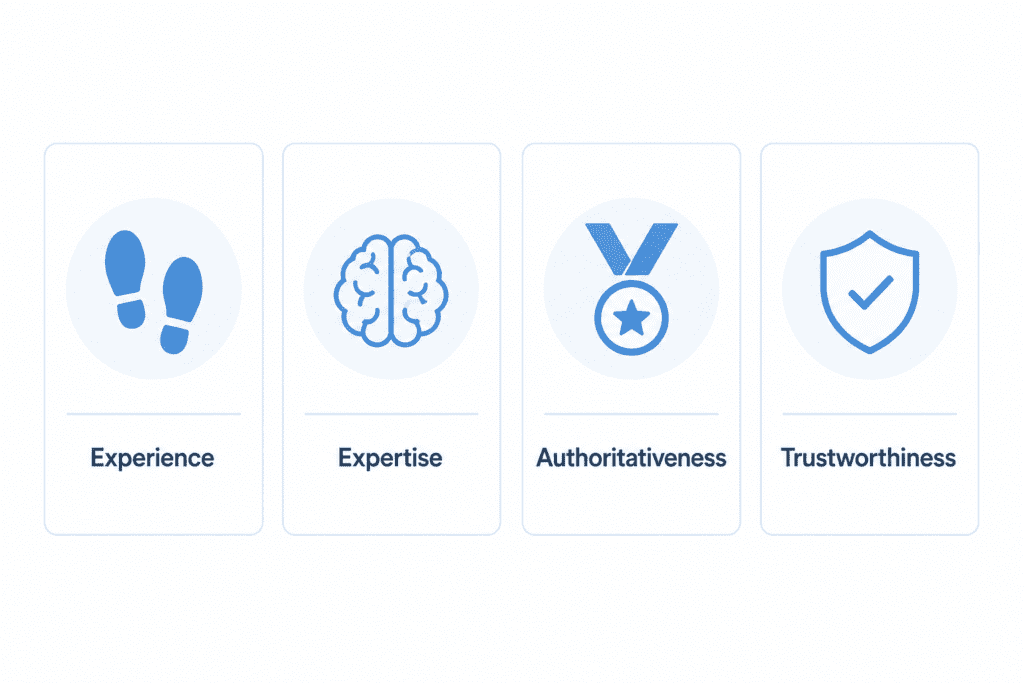
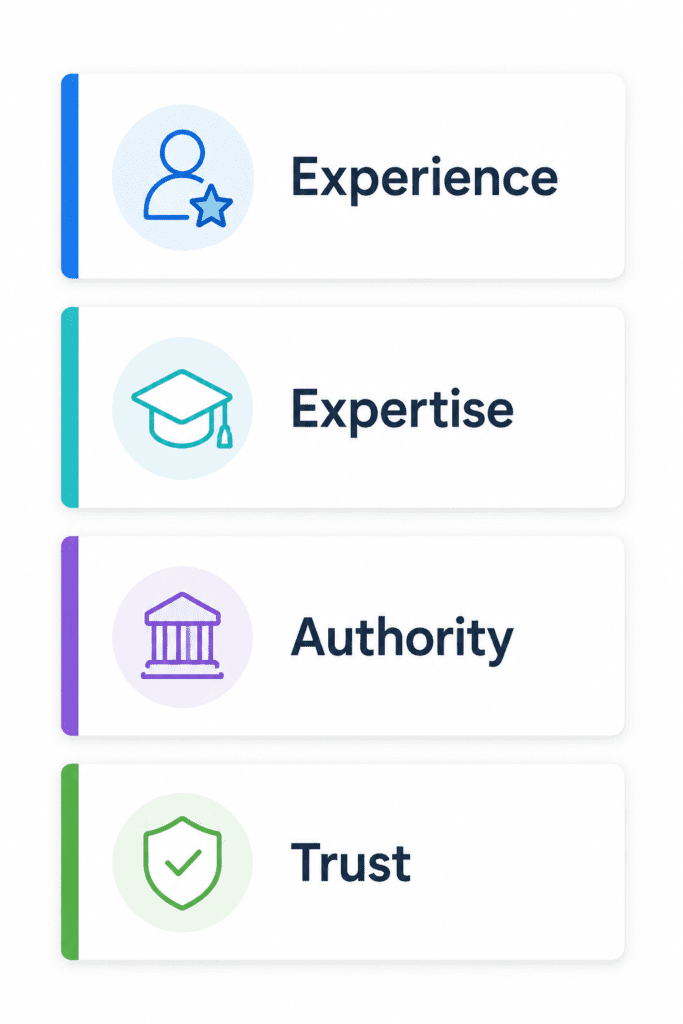
E-E-A-T stands for Experience, Expertise, Authoritativeness, and Trustworthiness. It is a framework used by Google’s quality raters to evaluate the overall quality and credibility of web content.
Google introduced the original E-A-T concept in its Search Quality Evaluator Guidelines — a document used to train human reviewers who assess the quality of search results. In December 2022, Google added a second “E” for Experience — upgrading the framework to E-E-A-T and emphasizing the importance of first-hand, real-world experience in content creation.
Breaking down each component:
Experience — Does the content creator have genuine, first-hand experience with the topic they’re writing about? A travel blogger who has actually visited the destinations they write about demonstrates experience. A financial writer who has personally invested demonstrates experience.
Expertise — Does the creator have deep knowledge or formal qualifications in the subject? A medical article written by a doctor demonstrates expertise. An SEO guide written by someone who has successfully ranked dozens of websites demonstrates expertise.
Authoritativeness — Is the creator or website recognized as a go-to resource in their niche? Are other credible sites linking to and citing their content? Authoritativeness is built over time through reputation, backlinks, and consistent quality.
Trustworthiness — Is the website honest, transparent, and safe? Does it have clear authorship, privacy policies, accurate information, and secure connections? Trust is the foundation that the other three components rest on.
Is E-E-A-T a Direct Ranking Factor?
This is one of the most debated questions in SEO — and the honest answer is nuanced.
E-E-A-T itself is not a direct algorithmic ranking signal that Google’s algorithm measures with a single score. There is no “E-E-A-T meter” in Google’s system.
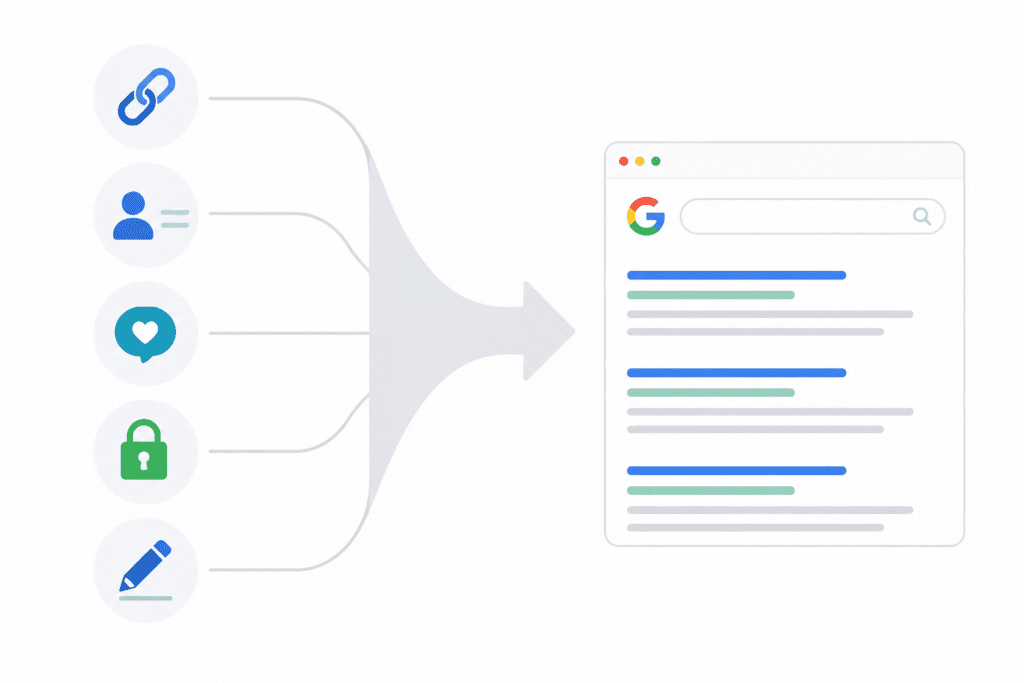
However, the signals that indicate E-E-A-T are used by Google’s algorithm. Things like:
- Backlinks from authoritative sites (authoritativeness signal)
- Author credentials and bylines (expertise signal)
- Positive user engagement metrics (trustworthiness signal)
- First-person experience described in content (experience signal)
- Secure website with clear policies (trustworthiness signal)
Think of E-E-A-T as the underlying quality that Google’s many algorithms are trying to detect. Improve your E-E-A-T signals — and your rankings improve.
Why E-E-A-T Matters More Than Ever in 2026
It matters beyond Google now, too — getting cited by ChatGPT, Perplexity and Claude rewards sourced, specific writing for much the same reasons.
Two major developments have made E-E-A-T critically important for bloggers in 2026:
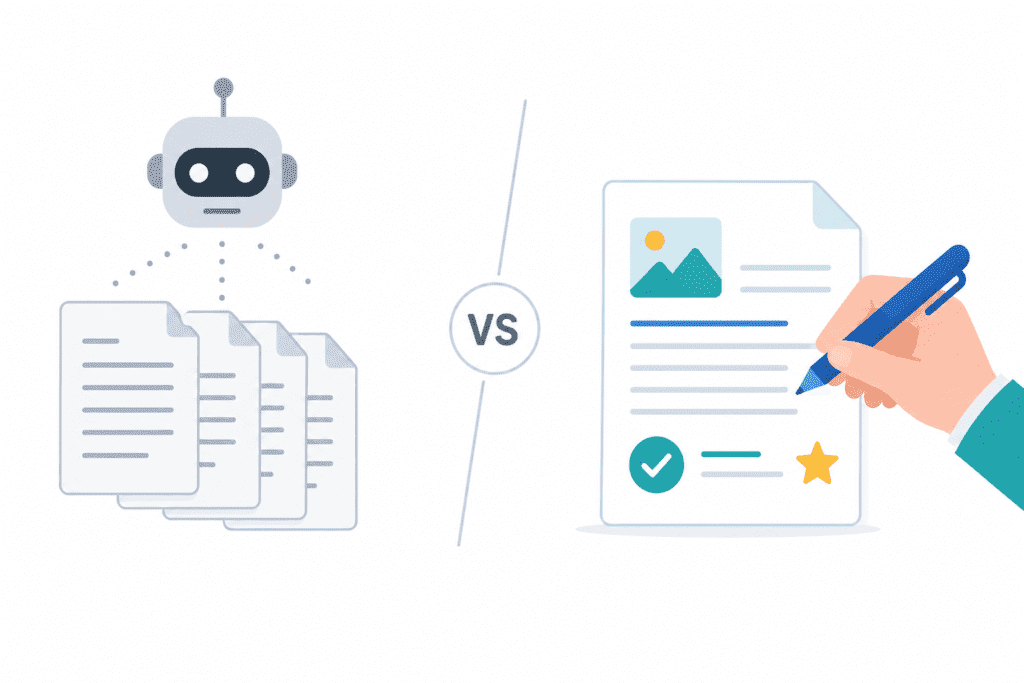
The rise of AI-generated content. The internet has been flooded with AI-generated articles that are technically accurate but lack genuine experience and insight. Google’s algorithm has become increasingly sophisticated at identifying and deprioritizing this type of content — and rewarding content that demonstrates real human experience.
This is actually good news for bloggers who genuinely know their subject and write from personal experience. Your authentic voice and real-world insights are your biggest competitive advantage over mass-produced AI content.
Google’s Helpful Content System: Google’s Helpful Content algorithm update specifically targets content written primarily for search engines rather than people. Content that demonstrates genuine E-E-A-T — written by real people with real knowledge for real readers — is exactly what this system rewards.
E-E-A-T by Niche: Why It Matters More for Some Topics

E-E-A-T standards vary significantly by topic. Google applies stricter E-E-A-T evaluation to what it calls YMYL topics — “Your Money or Your Life.”
YMYL topics include:
- Health and medical advice
- Financial advice and investing
- Legal information
- Safety and emergency information
- News and current events
For YMYL topics, Google holds content to the highest possible E-E-A-T standards because inaccurate information in these areas can directly harm people.
How to Improve E-E-A-T on Your Blog: Complete Guide
Improving Experience
Experience signals to Google that your content comes from someone who has actually done the thing they’re writing about — not just researched it.
Show your personal experience explicitly:
- Use first-person language: “When I tested this tool…” “In my experience…” “I’ve found that…”
- Share specific results: “After using this strategy for 3 months, my traffic increased by…”
- Include personal photos or screenshots where relevant
- Describe failures and what you learned — not just successes
Add personal case studies: Instead of writing generically about “how to make money blogging,” write about your own blog’s journey — what worked, what didn’t, what you’re still figuring out. This kind of authentic, experience-driven content is exactly what Google’s quality raters look for.
Share behind-the-scenes content: Show your actual workflow. Share your actual tools. Document your actual process. Specificity is the hallmark of genuine experience — and vagueness is the hallmark of content written without it.
Improving Expertise
Expertise demonstrates that you have deep, accurate knowledge of your subject — whether through formal credentials or demonstrated skill.
Display your credentials clearly: If you have relevant qualifications, certifications, or professional experience — put them on your About page and in your author bio. A software engineer writing about technical topics has expertise worth showcasing.
Write in-depth, comprehensive content: Surface-level articles that skim topics don’t demonstrate expertise. Deep, thorough guides that cover a subject completely — anticipating questions before they’re asked — signal genuine mastery.
Link to authoritative sources: Citing reputable sources (research papers, official documentation, industry reports) demonstrates that your content is grounded in verified information — a signal of expertise.
Correct your mistakes publicly: When you publish inaccurate information and later discover the error, update the article and note the correction. This transparency actually builds expertise signals rather than damaging them.
Create original research or data: Conduct surveys, analyze data, or document original experiments in your niche. Original research is one of the strongest expertise signals available to bloggers — and it attracts natural backlinks.
Improving Authoritativeness
Authoritativeness is largely about how others perceive and reference you — particularly other credible sources in your niche.
Build quality backlinks: Links from respected websites in your niche are the strongest authority signal. A single link from an authoritative SEO blog is worth more than 100 links from random, unrelated sites.
Strategies to earn quality backlinks:
- Guest post on established blogs in your niche
- Create comprehensive resource guides that others want to reference
- Produce original data or research that journalists cite
- Get listed in industry resource pages and directories
Get mentioned by other credible sources: Brand mentions — even without links — contribute to perceived authority. When other bloggers, journalists, or industry voices mention your work, it signals to Google that you’re a recognized voice in your space.
Build your personal brand alongside your blog: An author with an active LinkedIn profile, Twitter/X presence, and guest appearances on podcasts or other blogs is more authoritative than an anonymous website. Google’s quality raters look at authors — not just articles.
Earn recognition in your niche: Being cited in round-up articles, featured in “best blogs” lists, or invited to contribute expert quotes builds authoritativeness signals that no on-page optimization can replicate.
Improving Trustworthiness
Trust is the foundation of E-E-A-T — and without it, the other three signals mean very little.
Add these trust elements to your blog immediately:
About page with real information: Who you are, your background, your experience, why you started the blog, and how readers can contact you. An anonymous blog with no author information signals low trust.
Clear author bylines: Every article should have a named author. Add author bios with credentials and links to social profiles. Consider adding author photos — a real face dramatically increases trust signals.
Privacy policy and disclaimer pages: Required by law in most jurisdictions and expected by Google. Use a free generator (privacypolicygenerator.info) to create these if you don’t have them.
Affiliate disclosure: If you use affiliate links (you should), always disclose this clearly — at the top of every article containing affiliate links and in your site’s general disclosure page. Transparency builds trust; hiding commercial relationships destroys it.
HTTPS secure connection: Your blog must use HTTPS (the padlock icon in the browser). This is a basic trust signal and a confirmed Google ranking factor. Most good hosting providers include free SSL certificates.
👉Hostinger includes free SSL certificates on all hosting plans — essential for blog trust and SEO
Accurate, updated information: Outdated statistics, broken links, and factual errors damage trust signals. Review your most important articles annually and update them with current information.
Contact information: A working contact page — or at minimum a contact email — signals that there’s a real person behind the blog who stands behind their content.
E-E-A-T Signals Checklist for Bloggers
Run through this checklist and identify which signals you’re missing:
Experience signals:
- [ ] First-person language used throughout content
- [ ] Personal results and case studies shared
- [ ] Real screenshots and examples included
- [ ] Honest about limitations and what you don’t know
Expertise signals:
- [ ] Author credentials displayed on About page
- [ ] Comprehensive, in-depth articles (1,500+ words for competitive topics)
- [ ] Authoritative sources cited and linked
- [ ] Original insights beyond what’s already published
Authoritativeness signals:
- [ ] Backlinks from relevant, quality websites
- [ ] Author has presence beyond just the blog (LinkedIn, social media)
- [ ] Blog cited or mentioned by other sources
- [ ] Guest posts or contributions to other publications
Trustworthiness signals:
- [ ] HTTPS enabled (SSL certificate)
- [ ] About page with real author information and photo
- [ ] Privacy policy page published
- [ ] Affiliate disclosure on all relevant pages
- [ ] Contact page with working email
- [ ] Accurate, updated content throughout
Common E-E-A-T Mistakes Bloggers Make

Publishing anonymously: No author name, no author bio, no About page. This is one of the most damaging trust signals for a blog. Add a real name and bio immediately — even if you’re a beginner.
Copying competitor content structures without adding original value: If your article covers the exact same points in the exact same order as the top-ranking article, you’re not demonstrating expertise. You’re demonstrating that you can follow a template.
Never updating old content: An article from 2022 with 2022 statistics and outdated advice damages trust. Add “Last updated” dates and refresh content regularly.
Hiding commercial relationships: Not disclosing affiliate links or sponsored content violates FTC guidelines and destroys trust signals when discovered. Always disclose.
How TheHNSolutions Builds E-E-A-T
The clearest form of first-hand experience is writing up what actually went wrong. Four examples from running this site: what Rank Math got wrong on 174 pages, an affiliate tracking ID that was wrong on every product, the problems behind 46 browser-based tools, and cutting 39 KB of HTML from every page. None of those could be written without having done the work.

For transparency — here’s how we apply these principles on this blog:
Authoritativeness: We’re building this through consistent, high-quality content that earns backlinks and reader trust over time. Every article we publish strengthens our topical authority in the make-money-online and AI tools space.
Trustworthiness: Clear affiliate disclosures on every monetized article, accurate information verified before publishing, and a transparent about page showing who is behind this blog.
We’re not perfect — no blog is. But E-E-A-T is a continuous improvement process, not a destination.
Showing E-E-A-T on your own blog
In 2026, Google’s mission is simple: surface the most helpful, trustworthy, and expert content for every search query. E-E-A-T is the framework it uses to evaluate whether your blog meets that standard.
The good news: improving E-E-A-T doesn’t require technical SEO expertise. It requires:
- Writing from genuine experience
- Demonstrating your knowledge thoroughly
- Building your reputation consistently
- Being transparent and trustworthy with your audience
These are things any blogger can do — starting with their very next article.
📚 More Helpful Guides from TheHNSolutions: