
What Is Keyword Clustering? How It Works and Why It Matters

Most bloggers research keywords one at a time — find a keyword, write an article, repeat. It’s slow, inefficient, and leaves massive ranking opportunities on the table. Keyword clustering is the strategy that top SEO professionals use to build topical authority and rank for hundreds of keywords simultaneously. This guide explains exactly what it is, why it matters, and which tools do it best.
What Is a Keyword Cluster?
A keyword cluster is a group of related keywords that share the same search intent and can be targeted by a single piece of content — or by a structured group of interconnected articles.
Keyword Cluster Tool
Group related keywords into topics you can plan around.
Simple example: Instead of writing one article for “affiliate marketing” and another for “what is affiliate marketing for beginners,” a keyword cluster recognizes that these keywords share the same intent and can be targeted together in one comprehensive article.
But clustering goes further than that. It also groups related topics that should each have their own article — then connects them strategically through internal links, creating a content cluster that signals deep topical authority to Google.
The two types of keyword clusters:
1. Content clusters (same article): Multiple keywords that all point to the same search intent — one article targets all of them simultaneously.
2. Topic clusters (multiple linked articles): A pillar article covering a broad topic, surrounded by cluster articles covering subtopics, all interconnected through internal links.
Both types exist in every successful blog’s SEO strategy.
How Clustering Software Actually Groups Terms
A keyword cluster tool is software that automatically groups large lists of keywords into logical clusters — saving you from doing this manually across hundreds or thousands of keywords.
What it does:
- Takes a large list of keywords (which you input or it generates)
- Analyzes search engine results pages (SERPs) for each keyword
- Groups of keywords that Google shows similar results for (indicating shared intent)
- Organizes the clusters into a visual or structured content plan
- Often suggests which keyword should be the primary target for each article
Why this matters: Without a clustering tool, sorting 500 keywords into logical groups manually takes days. A clustering tool does it in minutes — and does it based on actual SERP data rather than just semantic similarity.
Why Keyword Clustering Matters for SEO in 2026
Google’s algorithm has become increasingly sophisticated at understanding topical authority — rewarding websites that comprehensively cover a subject rather than publishing isolated articles on random topics.
The topical authority advantage: A blog that has 10 deeply interconnected articles about affiliate marketing signals to Google that it’s an authoritative resource on that topic. A blog that has 1 article about affiliate marketing, 1 about recipes, and 1 about travel signals nothing, and ranks for nothing reliably.
Keyword clustering is the practical implementation of the topical authority strategy. It shows you:
- Which topics to cover to become an authority in your niche
- How to connect your articles so Google sees your site as a comprehensive resource
- Which keywords to target in which articles for maximum ranking efficiency
The ranking multiplier effect: When you cluster keywords correctly, one well-optimized article can rank for dozens or even hundreds of related keywords simultaneously — not just the primary keyword you targeted. This multiplies your traffic without multiplying your content volume.
How Keyword Clustering Works: A Practical Example
Let’s use TheHNSolutions’ niche to demonstrate:
Starting keyword: “make money online”
Without clustering: You write one article about “make money online” and hope it ranks. It doesn’t — because this keyword has massive competition and you haven’t built authority.
With clustering:
Step 1: You put “make money online” into a clustering tool.
Step 2: The tool generates and clusters hundreds of related keywords:
Cluster 1 — Pillar: Make Money Online (Broad)
- make money online
- How to make money online
- make money online for beginners
- make money online 2026
Cluster 2 — Blogging
- make money blogging
- How to start a blog and make money
- blogging income
- monetize a blog
Cluster 3 — Freelancing
- make money freelancing
- freelancing for beginners
- How to get freelance clients
- best freelancing skills
Cluster 4 — AI Tools
- make money with AI
- AI tools to make money
- How to earn with AI
Cluster 5 — Affiliate Marketing
- affiliate marketing for beginners
- best affiliate programs
- How to start affiliate marketing
Step 3: You build a content plan where each cluster becomes a group of related articles — all interconnected
Step 4: Google sees a comprehensive resource covering making money online from every angle — and ranks you for the entire topic cluster
This is exactly what TheHNSolutions is building — and keyword clustering tools accelerate that process dramatically.
Which Clustering Software Is Worth Paying For
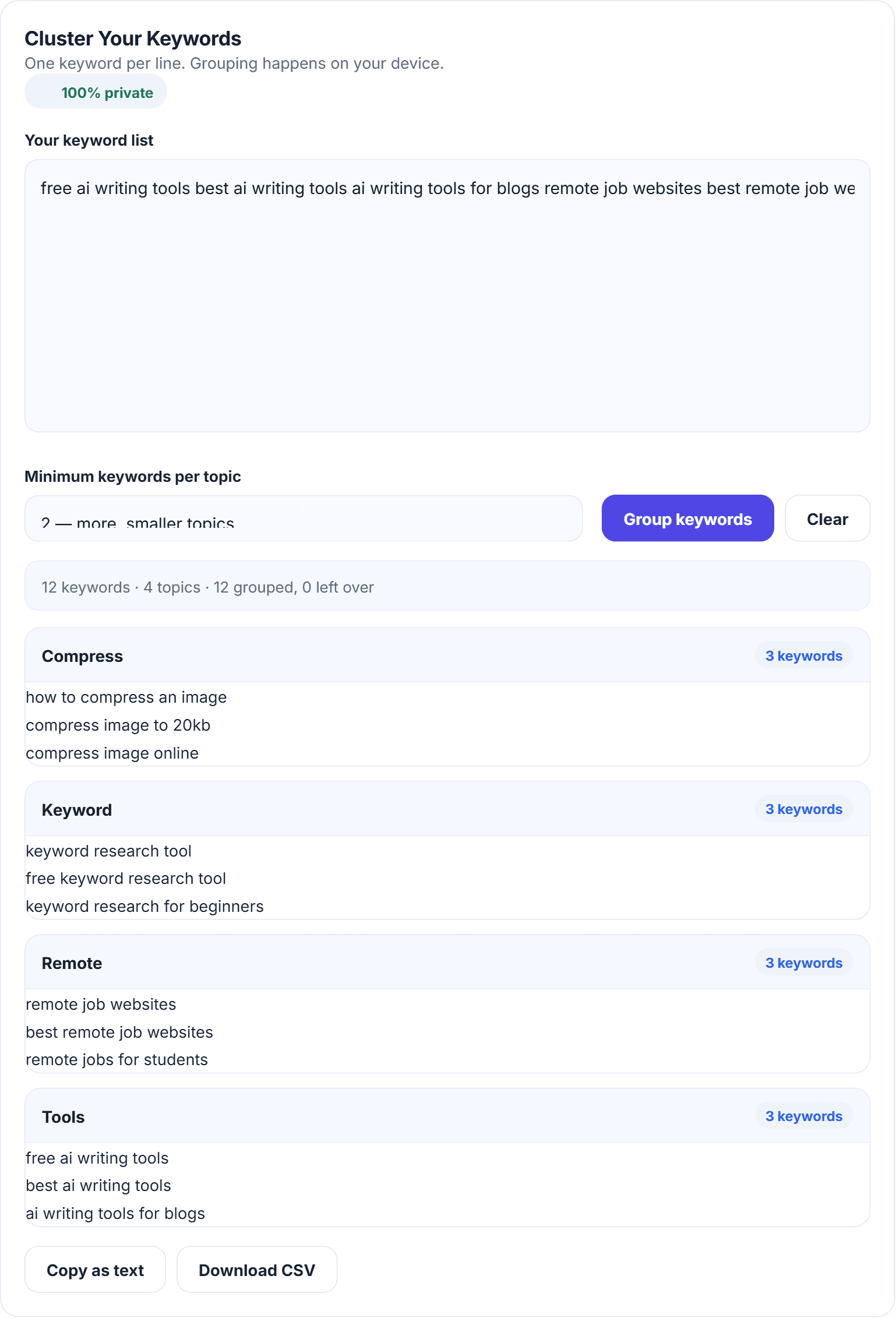
Before the paid options: if you only need a list sorted into topics, our free keyword clustering tool does that in your browser with no sign-up. The tools below earn their fee by comparing live search results, which is a different and more expensive job.
1. Keyword Insights — Best Overall Clustering Tool
Price: From $58/month | Free trial available
Best for: Serious bloggers and content marketers
Keyword Insights is the most purpose-built keyword clustering tool available. It uses actual SERP data — analyzing what Google shows for each keyword — to group keywords with genuine intent alignment rather than just semantic similarity.
Key features:
- Upload up to 200,000 keywords for clustering
- SERP-based clustering (most accurate method)
- Content brief generation for each cluster
- Search intent classification (informational, commercial, transactional)
- Keyword cannibalization detection
Why SERP-based clustering matters: Two keywords might seem semantically similar but have completely different search intent. “Best laptops for students” (commercial intent) and “laptop for student essay” (informational) look related but should be different articles. SERP-based clustering catches this.
Best for: Bloggers planning a large content operation who want the most accurate clustering available.
2. Semrush Keyword Magic Tool — Best for Research + Clustering
Price: From $139/month | Limited free version
Best for: Comprehensive SEO + clustering in one platform
Semrush’s Keyword Magic Tool includes clustering functionality built into one of the most powerful keyword research platforms available. If you’re already using Semrush for SEO, the clustering feature adds significant value without additional cost.
Key features:
- Massive keyword database (25+ billion keywords)
- Topic clustering by keyword grouping
- Search volume, difficulty, and CPC data
- Competitor keyword analysis
- Integration with position tracking and site audit tools
Free tier: 10 keyword searches per day — enough to test clustering on your most important topics.
3. Ahrefs Keywords Explorer — Best for Competitive Analysis
Price: From $99/month | Ahrefs Webmaster Tools free
Best for: Understanding keyword clusters in competitive niches
Ahrefs doesn’t have a dedicated clustering feature, but its “Also rank for” and “Parent topic” functionality effectively identifies cluster opportunities. Its keyword data is widely considered the most accurate available.
For free access: Ahrefs Webmaster Tools (free with your website verified) gives access to site audit and backlink data, though the full keyword explorer requires a paid plan.
4. Ubersuggest — Best Free Option for Beginners
Price: Free (3 searches/day) | $12/month for unlimited
Best for: Beginners starting with keyword clustering
Ubersuggest’s free tier provides enough keyword data for early-stage bloggers to begin building keyword clusters without any financial investment.
How to use for clustering (free method):
- Enter your pillar topic
- Export keyword suggestions
- Group manually by search intent
- Use the groups to plan your content calendar
It’s more manual than dedicated clustering tools — but it’s free and sufficient for blogs under 50 articles.
5. Claude AI — Best Free Clustering Assistant
Price: Free
Best for: Bloggers who want AI-assisted clustering without paid tools
This might be the most practical free option available in 2026. Claude can analyze a list of keywords and cluster them intelligently — for free.
The Claude clustering prompt:
“Here is a list of keywords related to my blog niche of [niche]: [paste keyword list]. Group these keywords into topic clusters where each cluster could be targeted by a single article or a group of related articles. For each cluster: (1) Name the cluster, (2) Identify the primary keyword, (3) List all related keywords in the cluster, (4) Suggest whether this should be one article or multiple connected articles, (5) Suggest a content format (pillar, cluster, supporting article).”
Limitation: Claude clusters by semantic meaning rather than SERP data, which is less accurate than dedicated tools for identifying true intent alignment. But for bloggers building their first content strategy, it’s remarkably useful and completely free.
6. Google Search Console — Free Cluster Discovery Tool
Price: Free
Best for: Finding cluster opportunities in your existing content
Google Search Console reveals which keywords your existing articles already rank for — which is invaluable for identifying clustering opportunities you haven’t capitalized on yet.
How to use it for clustering:
- Go to Search Console → Performance → Search Results
- Click on your best-performing articles
- See which other keywords each article ranks for
- Identify the keyword groups your articles are already associated with
- Create new supporting articles around those keyword groups
This is retroactive clustering — identifying what Google already thinks your content is about and deliberately expanding those topic clusters.
How to Build a Keyword Cluster Strategy: Step-by-Step
Step 1: Choose Your Seed Keywords (30 minutes)
Start with 5–10 broad topics that represent your niche. For TheHNSolutions:
- Make money online
- AI tools
- Affiliate marketing
- Blogging
- Freelancing
- Remote work
- Passive income
- SEO
These are your cluster “seeds” — each will generate dozens of related keyword clusters.
Step 2: Generate Keyword Lists (30–60 minutes)
For each seed keyword, use Ubersuggest (free) or your chosen tool to generate 50–200 related keywords. Export these to a spreadsheet.
Step 3: Cluster the Keywords (Using Tool or Claude)
Run your keyword lists through a clustering tool — or use the Claude prompt above for free clustering. The output should be organized into groups of related keywords.
Step 4: Assess Each Cluster
For each cluster, evaluate:
- Search volume: Is there enough demand to justify an article?
- Competition: Can a new blog realistically rank for these terms?
- Monetization: Does this cluster lead to affiliate opportunities or buyer intent?
- Relevance: Does this genuinely fit your blog’s niche and authority?
Step 5: Build Your Content Calendar
Map your clusters to a publishing schedule:
- Pillar articles first — your highest-volume, broadest topics
- Cluster articles next — supporting content that links to pillars
- Supporting articles last — highly specific, long-tail content
Step 6: Implement Internal Linking
As you publish, link cluster articles to their pillar and to each other. Every internal link strengthens the topical signal Google receives from your content cluster.
Free Keyword Clustering Method (No Tools Required)
If you’re not ready to invest in paid clustering tools, here’s a completely free method:
Step 1: Generate keywords using free tools
- Google autocomplete (type your topic and note suggestions)
- Google’s “People Also Ask” boxes
- Google’s “Related Searches” at the bottom of the results
- Ubersuggest free (3 searches/day)
- AnswerThePublic free (3 searches/day)
Step 2: Create a simple spreadsheet with columns: Keyword | Search Volume (estimated) | Cluster Group | Article Status
Step 3: Manually group by intent. Ask yourself: “Would someone searching [keyword A] and someone searching [keyword B] be satisfied by the same article?” If yes — same cluster.
Step 4: Use Claude to verify and expand. Paste your manual clusters into Claude and ask it to verify your groupings, suggest missing keywords for each cluster, and identify any keywords you may have misclustered.
Time investment: 2–3 hours for your first 100 keywords Cost: $0
Keyword Clustering Mistakes to Avoid
Mistake 1: Clustering by topic instead of intent: “Best AI tools” and “what are AI tools” look like the same topic — but “best” signals commercial intent (someone ready to choose a tool) while “what are” signals informational intent (someone learning basics). These need different articles.
Mistake 2: Making clusters too broad: “Make money online” is too broad for one cluster. Break it into sub-clusters: “make money online freelancing,” “make money online blogging,” “make money online with AI.” Each sub-cluster gets its own article group.
Mistake 3: Ignoring search volume entirely: A keyword cluster with zero search volume won’t drive traffic regardless of how well you rank. Prioritize clusters with demonstrated demand.
Mistake 4: Not building internal links: Clusters only work if the articles are connected. Every cluster article should link to its pillar, and the pillar should link back to all cluster articles.
Mistake 5: Building clusters and never publishing: Keyword clustering is a planning tool — not an end in itself. The value comes from executing the content plan it produces.
Final Thoughts: Clusters Beat Keywords Every Time
Individual keyword targeting is how blogs competed in 2015. Topical authority through keyword clusters is how blogs compete in 2026 — and win.
The blogs ranking at the top of Google for competitive terms aren’t there because they found a magic keyword. They’re there because they built comprehensive, interconnected content that convinced Google they’re the most trustworthy resource on their topic.
Keyword clustering is how you build that. Start with free tools — Claude, Ubersuggest, and your own analytical thinking. Graduate to paid tools when the investment is justified by your traffic and income.
The strategy doesn’t change. The tools just make it faster.
Explore more SEO guides on TheHNSolutions:
🔗 Best AI Tools for SEO in 2026
🔗 How to Do an SEO Audit for Free
🔗 What Is E-E-A-T in SEO and Why Does It Matter?