
Tidio vs Intercom vs Lindy for Small Business Support
Tidio, Intercom and Lindy compared on price, setup effort and what each one actually handles well for a small support team.

Support chatbot pricing has become genuinely difficult to compare, and that’s not an accident.
One platform charges per seat. Another charges per successful AI resolution. A third charges a base fee plus an AI add-on. Compare the headline numbers, and you’ll reach the wrong conclusion — the cheapest-looking option is frequently the most expensive once your volume is real.
The headline monthly price rarely tells the full story: some platforms charge a flat subscription, some per seat, some per AI resolution, and some combine a base plan with separate AI usage fees.
This article does the actual math on three platforms that represent three different philosophies, and tells you which fits which kind of business.
AI Prompt Generator
Build a properly structured prompt — role, task, tone, format — for any AI.
Pricing verified August 2026. Plans in this category change frequently — confirm on the vendor’s page before purchasing.
The Short Answer
Tidio — the right choice for most small businesses and e-commerce stores. Best balance of capability and price, fastest setup.
Intercom — the most capable platform here and priced accordingly. Right when each resolved conversation is worth real money, and you have the volume to justify it.
Lindy — different category. Less a support chatbot, more an AI agent that takes actions across your tools. Right if your problem is workflow, not just answering questions.
Understanding the Three Pricing Models
This section matters more than any feature comparison, so read it before the reviews.
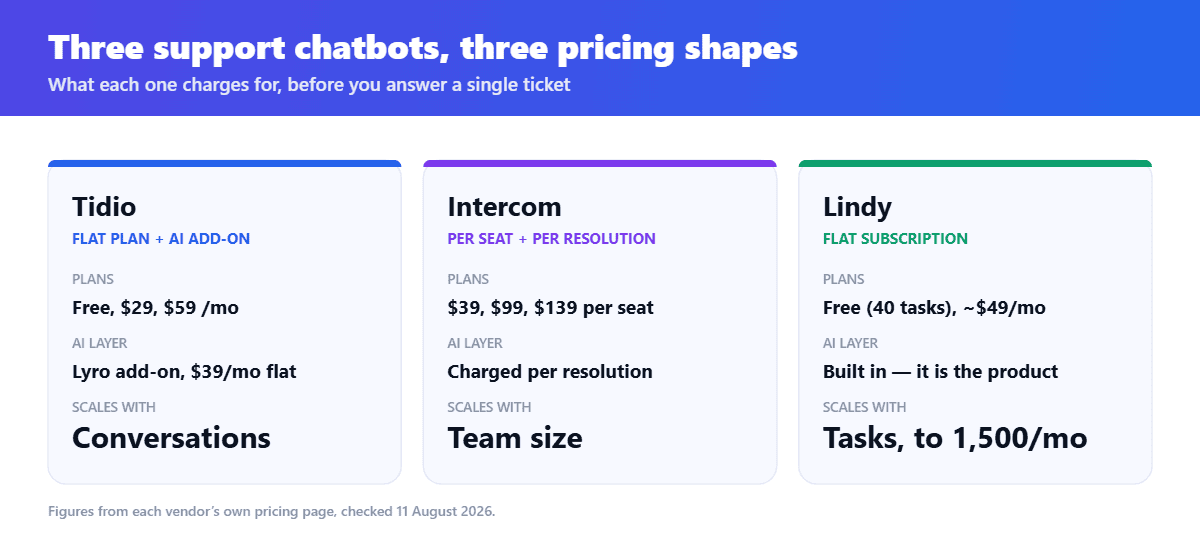
Tidio: base plan plus AI add-on. You pay for the customer service platform, then pay separately for the Lyro AI layer. Free is $0/mo, Starter is $29/mo, Growth is $59/mo, and the Lyro AI add-on is $39/mo as a flat fee that enables Lyro across your plan. Predictable, and you can start without AI and add it later.
Intercom: per seat plus per resolution. Intercom’s plan structure puts Essential at $39 per seat per month, Advanced at $99 per seat, and Expert at $139 per seat. On top of that, AI usage is billed separately at $0.99 per Fin resolution.
That per-resolution model sounds fair — you only pay when the AI actually solves something. It is fair. It’s also expensive at volume: 1,000 resolved conversations in a month is $990 in AI fees on top of your seats.
Lindy: flat subscription. Lindy sits around $49 per month, with a free version handling up to 40 tasks and paid access allowing up to 1,500 tasks per month.
The Comparison Nobody Runs
Take a small business handling 500 support conversations monthly, with two people on the team, where AI resolves 60% of them.
Tidio: Growth at $59 plus Lyro at $39 = around $98/month, flat, regardless of how many conversations the AI handles.
Intercom: two Essential seats at $39 each is $78, plus 300 AI resolutions at $0.99 = $297. Around $375/month.
Lindy: roughly $49/month, though it’s solving a somewhat different problem.
The gap isn’t small, and it widens as you grow. This is the single most important thing to understand before choosing.
Tidio: The Value Pick for Small Business
Tidio is built for exactly the kind of business reading this article.
What it is. An all-in-one customer service tool that lets businesses chat with website visitors, answer questions, and run email campaigns from a single dashboard, with the inbox, visitor tracker, campaign tools, and chatbot settings in one place. Its AI layer is called Lyro.
Performance. Tidio offers the best AI chatbot value for small businesses at $29–$79/month with 55–65% automated resolution. Roughly six in ten conversations handled without you is a meaningful reduction in support load.
Free tier. Tidio’s free tier includes 50 conversations a month — enough to genuinely test it on a live site.
Setup time. Hours, not days. Install the script, point Lyro at your existing FAQ or help content, test it, go live.
Where it falls short. For larger companies with separate billing, tech, and sales departments, Tidio’s routing can feel basic. It’s built for small teams and shows it above a certain size.
Best for: E-commerce stores, local service providers, and startups that need capable AI without enterprise complexity.
Intercom: The Capable, Expensive Option
Intercom is the most powerful platform here. Whether that power is worth the price depends entirely on your economics.
What it is. Intercom brings live chat, email, in-app messaging and automation into one workspace, with workflow builders, routing rules, multilingual help centers and multiple inboxes for larger teams. Fin, the built-in AI agent, resolves common questions, and Copilot helps human agents respond faster.
Reputation. Fin is well rated on G2 at 4.5/5, with users highlighting ease of use and strong automation.
Setup. Installing the script and identifying users requires some development work for full power, then mapping data fields, setting up Fin’s knowledge base and building workflows — around two to five days to value.
The honest verdict on cost. For most small businesses Tidio is the correct choice, giving most of the power of a modern AI chatbot at a fraction of the cost — but for a rapidly scaling SaaS company or a large brand where every successful resolution is worth significantly more than $0.99, Intercom pays for itself, with data insights and proactive messaging that are unmatched in the enterprise space.
That $0.99 figure is the whole decision. If a resolved conversation is worth $50 to you because it prevents a churned subscription, paying a dollar is obviously correct. If you sell $30 products, it isn’t.
Best for: funded SaaS companies, businesses with high customer lifetime value, teams already running multi-department support.
Lindy: The AI Agent Alternative
Lindy belongs in this comparison but doesn’t compete on the same axis.
What it is. An AI agent platform rather than a support inbox. The distinction matters: a chatbot responds to questions conversationally, while an AI agent performs actions — updating your CRM, sending emails, scheduling meetings, and triggering workflows between integrated tools.
What that means practically. A support chatbot tells a customer where their order is. An agent checks the order system, finds the delay, issues the discount code, updates the CRM, and emails the customer — then tells you it happened.
Building it. Lindy offers a drag-and-drop workflow builder that requires no technical skills.
Pricing. The free version handles up to 40 monthly tasks; the paid version allows up to 1,500 tasks per month. Note that it’s task-based, so heavy conversation volume will hit that ceiling.
Where it falls short as pure support software: It isn’t a full support desk. No sophisticated live-chat inbox for a human team, less mature as a customer-facing widget.
Best for: solopreneurs and small teams whose support burden is really an operations burden — where the answer to most questions requires doing something in another system.
Head to Head
| Tidio | Intercom | Lindy | |
| Model | Base + AI add-on | Per seat + per resolution | Flat, task-based |
| Entry price | $29/mo (+$39 AI) | $39/seat + $0.99/resolution | ~$49/mo |
| Free tier | 50 conversations/mo | 14-day trial | 40 tasks |
| AI resolution rate | 55–65% | Highest of the three | Varies by workflow |
| Setup time | Hours | 2–5 days | Hours to days |
| Cost predictability | High | Low — scales with volume | High |
| Takes actions in other tools | Limited | Yes, via workflows | Core strength |
| Best for | Small business, e-commerce | High-value SaaS | Ops-heavy solo/small teams |
How to Choose
Start with one number: what is a resolved support conversation worth to you?
Under $10 — Tidio. Per-resolution pricing will never make sense at your economics.
Over $50 — Intercom is defensible, likely correct if you also have the volume.
Then ask: is your support problem answering, or doing? If customers mostly need information you already have written down, Tidio or Intercom. If most requests require you to go do something in another system, look seriously at Lindy or pair a chatbot with an automation platform.
Finally: how much setup time do you actually have? Intercom’s two-to-five days assumes someone technical is available. If that’s you and you’re also doing everything else, the real timeline is longer.
A closing suggestion: whatever you pick, spend an hour first writing down the fifteen questions customers actually ask most. Every platform here performs dramatically better with good source material, and no amount of AI compensates for a thin knowledge base. The businesses disappointed by support chatbots are usually the ones that skipped this step.
Worth being blunt about. A chatbot that cannot resolve a question is a speed bump between a customer and a human. Measure resolution rate, not deflection rate — they are not the same number.
Chatbot questions worth asking first
What’s the cheapest AI chatbot for a small business? Tidio, once you account for total cost at realistic volume. Its flat AI add-on stays predictable where per-resolution pricing climbs with usage.
Is Intercom worth it for a small business? Usually not, on cost. It becomes worth it when customer lifetime value is high enough that each resolved conversation justifies the per-resolution fee.
What’s the difference between an AI chatbot and an AI agent? A chatbot answers questions. An agent takes actions in your other tools — updating records, sending emails, triggering workflows. Lindy is the agent option here.
Can I try these free? Yes. Tidio’s free tier covers 50 conversations a month, Lindy offers 40 free tasks, and Intercom runs a 14-day trial.
How much support volume can AI actually handle? Expect around 55–65% automated resolution for a well-configured small business setup. Higher rates are achievable with strong documentation and narrow scope.
Do I still need human support, staff? Yes. AI handles the repetitive majority; the remainder is exactly the portion where a frustrated customer most needs a person. Plan for escalation from day one.
More on AI automation
Related reading on HN Solutions.