
ATH-M50x vs Sony WH-1000XM5: Sound Per Pound vs Silence
A decade-old wired pair against a flagship with eight microphones. They are not competing — they solve different problems.

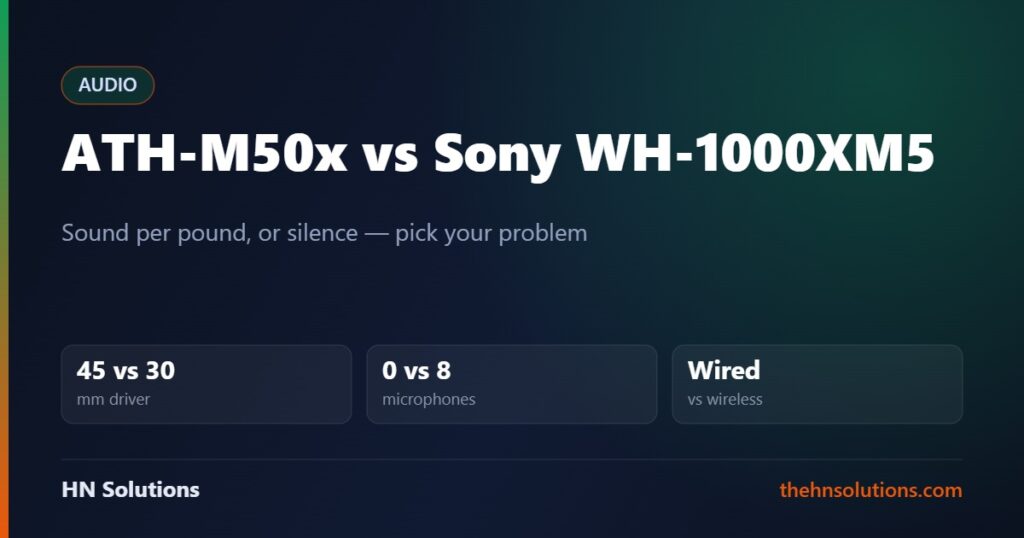
One of these has no battery, no app, no Bluetooth and no noise cancellation, and has been recommended continuously for over a decade. The other is a flagship with twelve microphones and a processor. Comparing them looks unfair until you notice they are solving different problems.
This is a research-based comparison, not a hands-on test. Read our review standards. Full write-ups: ATH-M50x and Sony WH-1000XM5.
The short answer
M50x if your room is quiet and you want the most sound per pound. No battery to die, no firmware, no Bluetooth compression, replaceable cables and pads, and a tuning people have trusted for years.
XM5 if your room is not quiet. Cancellation, multipoint Bluetooth and a 30-hour battery solve problems the M50x does not attempt. You pay considerably more for capability, not for better sound.
Where the money actually goes
| ATH-M50x | Sony WH-1000XM5 | |
|---|---|---|
| Connection | Wired, detachable cable | Bluetooth and wired |
| Noise cancellation | None — passive isolation only | Active, 8 microphones |
| Battery | None needed | 30 hrs ANC on / 40 off |
| Driver | 45 mm | 30 mm |
| Weight | Approx. 285 g | 250 g |
| Folds | Yes | No |
| Multipoint | Not applicable | Yes, two devices |
| Codecs | Not applicable | SBC, AAC, LDAC |
| Replaceable parts | Cables and earpads | Earpads |
| App and EQ | None | Yes, 5-band |
Read that list and the price difference stops being mysterious. You are not buying better drivers — you are buying a radio, a battery, eight microphones, a processor and the software to run them.
The wired advantage nobody mentions
A cable carries the full signal. Bluetooth compresses it, even with LDAC, and adds latency.
For most listening the difference is small — considerably smaller than the difference a good ear-pad seal makes. But it is a real advantage, and it comes with three practical ones that matter more day to day:
- Nothing to charge. The M50x cannot run out of battery mid-flight
- Nothing to update. No firmware, no app, no account
- Nothing to obsolete. A pair from a decade ago works exactly as it did, because there is no software in the path
That last point is the reason these keep getting recommended. Wireless headphones are consumer electronics with a lifespan set by a battery. Wired headphones are a tool.
What cancellation is actually worth
Be precise about this, because it is where the money goes.
Active cancellation works on steady, low-frequency sound — aircraft engines, train carriages, air conditioning, server hum. It removes those extremely well, and nothing passive comes close.
It works far less well on speech and sudden noise. The conversation behind you is not going anywhere on any headphones, at any price.
The M50x’s closed back provides real passive isolation, which handles a moderate amount of ambient noise. It just does nothing about a jet engine.
Sound, described fairly
Neither is neutral, and they are not neutral in different directions.
The M50x is tuned with lifted bass and a forward upper midrange — energetic and detailed, sometimes described as bright. It has been a studio staple for years, though it is a monitoring tool rather than a reference-flat one.
The XM5 is tuned for a broad audience: a modest bass lift and a smooth, forgiving treble, adjustable in Sony’s app. The app is the XM5’s real sound advantage — the M50x sounds the way it sounds, and your only adjustment is system EQ.
At this price, the larger 45 mm driver in the M50x is doing its work without a processor in the path. Whether you prefer that is genuinely a preference.
Which one should you buy?
Choose the M50x
- You listen at a desk in a quiet room
- You want maximum sound quality per pound
- You dislike charging things
- You want replaceable cables and earpads
- You need zero latency — monitoring or editing
- You want them working in ten years
Choose the XM5
- You commute, fly or work in an open-plan office
- You want wireless
- You take calls on your headphones
- You want multipoint between laptop and phone
- You want app EQ and adjustable tuning
- A cable is a dealbreaker
The unglamorous third option
Buy the M50x and use it at your desk, and keep cheap earbuds for the commute. Two purposes, two products, often less money than one flagship — and the desk listening is better than the flagship would have given you.
If you do want cancellation, it is worth knowing what the newer generation changed before you choose: our XM6 versus XM5 comparison shows more than half the published specifications are identical.
What this comparison cannot tell you
We have not measured frequency response or isolation, or compared them on a plane. The tuning descriptions reflect the consistent characterisation across independent reviews of both models.
Comfort is the variable we cannot assess. The M50x clamps more firmly, which some find secure and others find tiring after two hours. The XM5 is lighter with softer pads. Head shape decides it.
Frequently asked questions
Is the ATH-M50x still worth buying?
For quiet-room listening, yes. There is no battery to degrade, no firmware to abandon, and replaceable cables and earpads mean it can be maintained rather than replaced. That is unusual in headphones at any price.
Do wired headphones sound better?
Marginally, because there is no Bluetooth compression or latency. The difference is real but smaller than people expect — and considerably smaller than the difference between a good and a poor ear-pad seal.
Will the M50x block office noise?
Partly. The closed back gives real passive isolation against moderate ambient noise, but nothing against low-frequency drone. For that you need active cancellation.
Can I use the XM5 wired?
Yes. It has a 3.5 mm jack and works passively with no battery, though cancellation and app features need power. It is a useful fallback rather than a reason to choose it.
Which is more comfortable?
Usually the XM5 — lighter, softer pads, less clamping force. The M50x clamps more firmly, which holds a seal well and can become tiring over long sessions. Head shape matters more than either specification.
Which for video calls?
The XM5, easily. It has microphones designed for voice, multipoint switching between laptop and phone, and no cable to manage. The M50x has no microphone at all.
- Audio-Technica ATH-M50x review
- Sony WH-1000XM5 review
- Sony XM6 vs XM5 — what the newer generation changed
- AirPods Pro vs Bose QC Ultra — the earbud version of this question
- Audioengine A2+ — speakers, if the room allows
Sources. Specifications are the manufacturers’ own published figures for the Audio-Technica ATH-M50x and the Sony WH-1000XM5. Tuning descriptions reflect independent review reporting rather than our own measurement. We have not tested this ourselves and do not claim to have.