How to Build an Automated SEO & Content Cluster Workflow Using Free AI Tools

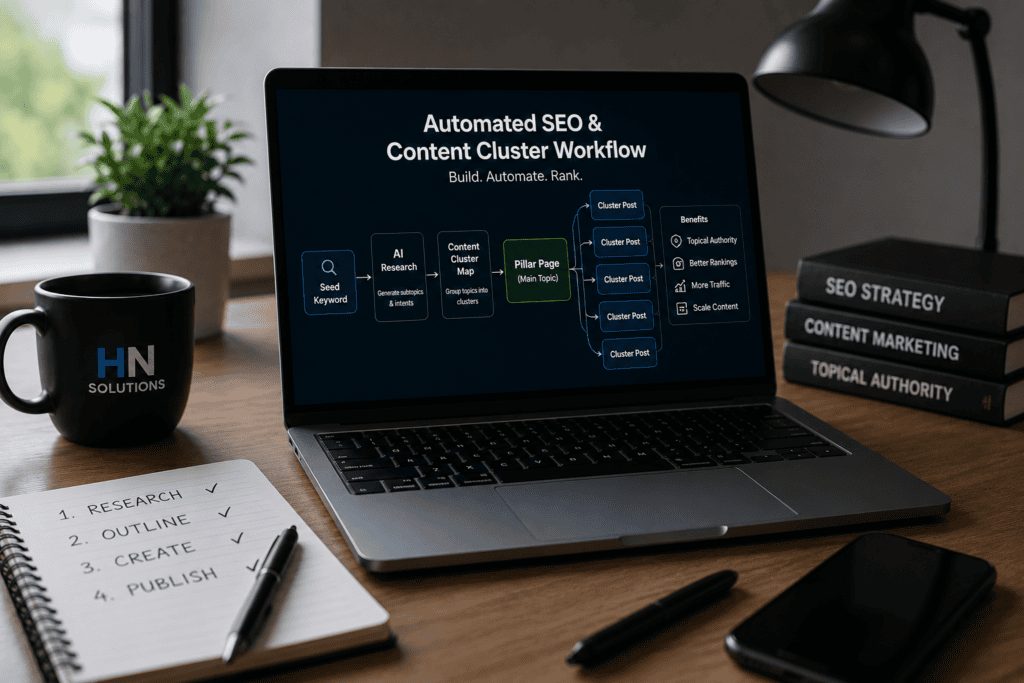
Building topical authority is no longer optional in modern search engine optimization. Search algorithms like Google’s Helpful Content System and Generative AI engines (ChatGPT, Perplexity, Claude) prioritize websites that cover a domain top-to-bottom rather than sites publishing isolated, one-off articles.
When you cover every angle of a topic through an interconnected network of pages, search engines view your domain as a primary source. However, manually researching, mapping, outlining, and drafting a 20-article content cluster takes dozens of hours.
By combining browser-based AI prompt frameworks with clear semantic mapping, you can automate up to 80% of the content cluster lifecycle—without spending hundreds of dollars on paid enterprise SEO suites.
1. The Anatomy of a High-Ranking Content Cluster
A content cluster consists of three structural components designed to signal total niche coverage to search engines and AI web scrapers:
[ Pillar Page: High-Volume Keyword ]
|
+—————————–+—————————–+
| | |
[ Subtopic 1 ] [ Subtopic 2 ] [ Subtopic 3 ]
(Supporting Article) (Supporting Article) (Supporting Article)
| | |
+—————————–+—————————–+
|
[ Interlinked Contextual Web ]
- The Pillar Page: A broad, comprehensive resource covering a core topic in depth (e.g., “The Complete Guide to Remote Work Productivity”).
- Cluster Articles: 5 to 15 specialized supporting posts covering specific subtopics in granular detail (e.g., “Best Time-Zone Planning Tools for Remote Teams”).
- Bidirectional Internal Links: Hyperlinks that connect every cluster post back to the pillar page, and cross-link relevant supporting articles to each other.
Publisher Tool: Need structured system prompts for your cluster? Use the free HN Solutions AI Prompt Generator to build optimized prompts for ChatGPT and Claude instantly inside your browser.
2. Step-by-Step Automated AI Content Workflow
1. Phase 1: Generate Semantic Sub-Clusters with AI: Extract subtopics and group them by search intent using master prompts.
Prompt ChatGPT or Claude to act as a Senior SEO Strategist. Request a breakdown of a primary seed keyword into distinct search intents: Informational, Commercial, and Transactional.
Copy and run this exact master prompt:
Plaintext
Act as a Senior SEO & GAIO Strategist. I am building a content cluster around the primary seed topic: “[INSERT SEED TOPIC HERE]”.
Generate 10 distinct long-tail article topics that support this seed keyword.
Group them into 3 sub-clusters based on user intent (Informational, Commercial, Problem-Solving).
For each topic, provide:
1. Proposed H1 Article Title
2. Primary Target Keyword
3. 3-4 High-Relevance Semantic Entities to include
Output the final result inside a clean Markdown Table.
2. Phase 2: Establish Unique Entity Maps & Target Keywords: Avoid keyword cannibalization before writing a single word.
Feed your cluster topics back into an AI prompt builder to define the primary keyword, secondary entities, and intent target for every article. Ensure no two articles target the same primary keyword, preventing your own pages from competing against each other in SERPs.
3. Phase 3: Generate Deep Structural Outlines: Create machine-readable outlines built for LLM extraction.
Generate an outline for each cluster piece, enforcing BLUF (Bottom Line Up Front) headings, comparison tables, and a strict H2/H3 hierarchy.
Use this outline generation prompt:
Plaintext
Create a comprehensive article outline for: “[INSERT ARTICLE TITLE]”.
Ensure the structure includes:
– H1 Title optimized for Search and Click-Through Rate
– Direct definition/summary block right after H1 (BLUF format)
– 4-5 detailed H2 sections with nested H3 subsections
– At least one comparison Markdown Table
– An ordered step-by-step execution list (<ol>)
– A dedicated FAQ section addressing long-tail PAA (People Also Ask) questions
4. Phase 4: Draft, Audit, and Insert Interlinks: Refine drafts with technical data, first-party proof, and interlinks.
Draft the content using your custom prompt rules. Ensure every supporting article includes 2–3 exact contextual links pointing back to your main Pillar Page, using descriptive, entity-rich anchor text instead of generic text like “click here.”
3. Comprehensive Comparison: Manual vs. Automated AI Workflows
| Performance Category | Manual Cluster Creation | Automated Free AI Workflow |
| Research & Mapping Time | 8 to 12 Hours per cluster | 15 to 30 Minutes per cluster |
| Tool Costs | $99–$299/month (Paid Suites) | $0 / Free (Browser Utilities + LLMs) |
| Entity Richness | Inconsistent across different writers | High (Enforced via system prompts) |
| Outlining Efficiency | 45 minutes per article | 2 minutes per article |
| Scalability | 2–3 clusters per month | 10+ clusters per month |
| GAIO Readiness | Frequently missed formatting rules | Built directly into outline prompts |
4. Advanced GAIO Tip: Preserving Entity Context Across Clusters
When linking cluster articles together, avoid generic anchor text like “click here” or “read more.” Instead, use entity-rich anchor phrases that clearly tell AI crawlers what the destination page covers.
- Weak Anchor Text: To learn about privacy tools, [read this article].
- Optimized Entity Anchor: Learn why local execution protects sensitive user data in our deep dive on [browser-based vs. server-side online tools].
💡 Publisher Tool: Need structured system prompts for your content cluster? Use the free HN Solutions AI Prompt Generator to build custom, high-density prompts for ChatGPT and Claude directly in your browser without paywalls.
5. Frequently Asked Questions (FAQ)
Q: Will AI-generated SEO content get penalized by Google?
A: Google explicitly states that it rewards high-quality content regardless of how it is produced. However, unedited, low-effort AI copy that lacks original insights or proper formatting will struggle to rank. Always edit AI drafts for accuracy, brand voice, and formatting.
Q: How many supporting articles should a pillar page have?
A: Most competitive topics require between 5 and 15 supporting articles to establish complete topical authority. For smaller local or hyper-niche topics, 3 to 5 well-optimized pieces are often sufficient.
Reference. Before automating anything at scale, read Google Search Central’s helpful content documentation.