
AI Job Titles Explained: Prompt Engineer and the Rest

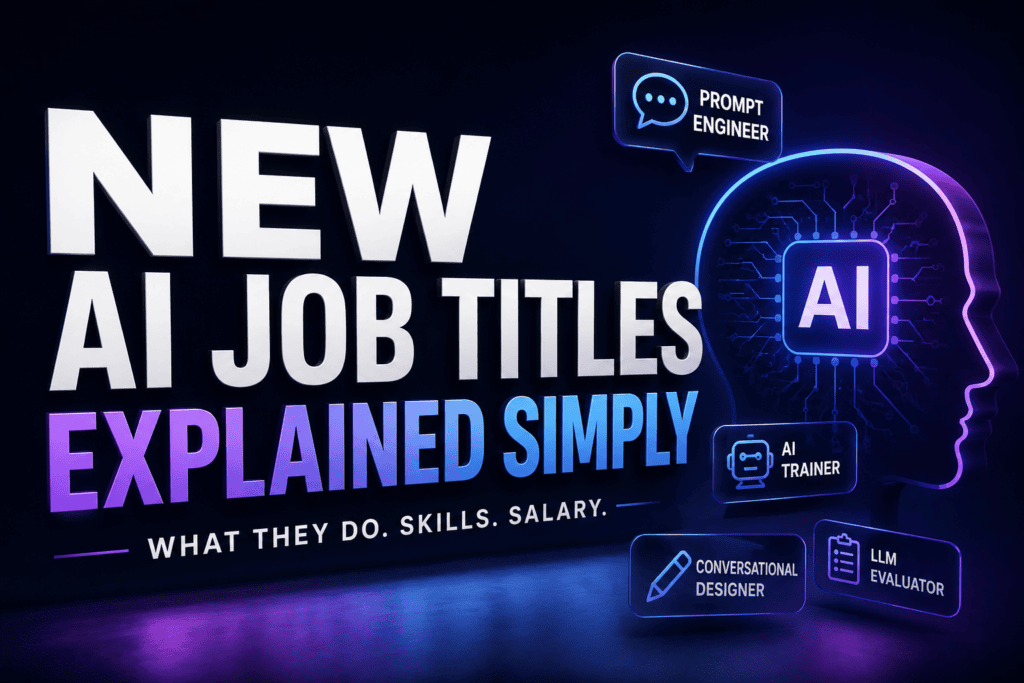
Job boards in 2026 are full of titles that didn’t exist three years ago. Prompt Engineer. AI Trainer. LLM Evaluator. Conversational Designer. If you’ve been wondering what these roles actually involve — who does the work, what skills they require, and how much they pay — this guide gives you the honest, plain-English breakdown.
Why New AI Job Titles Are Confusing
The AI industry is moving faster than professional vocabulary can keep up with. Companies are inventing job titles as they go — which means the same role might be called “Prompt Engineer” at one company and “AI Content Specialist” at another. “AI Trainer” at one organization means something completely different at another.
This guide cuts through the confusion by explaining what the work actually involves — regardless of what any particular company chooses to call it.
The New AI Job Landscape: An Overview
AI has created new roles across three broad categories:
Category 1: Working with AI models directly. Roles where your primary job is interacting with, training, evaluating, or improving AI systems.
Category 2: Applying AI in creative and professional work: Roles where AI is a primary tool you use to produce outputs — content, code, design, strategy.
Category 3: Governing and overseeing AI Roles focused on ensuring AI is used safely, ethically, and effectively within organizations.
All three categories have roles accessible to people without computer science degrees, which is why this matters for a broad audience.
AI Job Title #1: Prompt Engineer
What it actually is
A prompt engineer designs, writes, tests, and optimizes the instructions (prompts) given to AI systems to produce desired outputs. They are, essentially, experts at communicating with AI — knowing exactly how to phrase instructions to get reliable, high-quality results.
Think of it as writing very precise instructions for an extraordinarily capable but literal assistant. The skill is understanding how AI interprets language and structuring your requests accordingly.
What the work looks like day-to-day
- Writing system prompts that define how an AI assistant behaves for a specific use case
- Testing prompts with different inputs to ensure consistent, accurate outputs
- Documenting prompt libraries for teams to use
- Collaborating with developers and product managers to improve AI feature performance
- Iterating prompts based on user feedback and failure analysis
Skills required
- Strong written communication and precision with language
- Analytical thinking — understanding why a prompt worked or failed
- Domain knowledge in the application area (customer service, legal, healthcare, etc.)
- Basic understanding of how large language models work (not coding — conceptual understanding)
- Patience for systematic testing and iteration
Does it require coding?
Not necessarily. Many prompt engineering roles require no coding at all — particularly in content, customer experience, and creative applications. Technical roles working with model APIs may require basic Python.
Salary range
$60,000–$165,000/year in the US, depending on specialization and company size. Some senior positions at major AI companies exceed $200,000.
How to get into it
- Build a personal prompt library demonstrating results across different use cases
- Document prompt experiments publicly (blog, GitHub, LinkedIn)
- Apply for AI content specialist or AI tool roles as entry points
- Courses: Anthropic’s prompt engineering documentation, DeepLearning.AI’s prompt engineering course
AI Job Title #2: AI Trainer / RLHF Specialist
What it actually is
AI trainers (sometimes called RLHF specialists — Reinforcement Learning from Human Feedback) are the people who teach AI systems what good looks like. They evaluate AI outputs, provide feedback, rank responses, flag errors, and help models learn from human judgment.
When you give a thumbs up or down to an AI response — somewhere, an AI trainer did the same thing thousands of times to help the model learn which responses are better.
What the work looks like day-to-day
- Reviewing AI-generated responses and rating their quality, accuracy, and helpfulness
- Writing ideal responses that demonstrate what good output looks like
- Identifying subtle errors, biases, or problematic patterns in AI outputs
- Testing AI behavior across edge cases and unusual inputs
- Providing structured feedback according to detailed guidelines
Skills required
- Strong reading comprehension and critical thinking
- Excellent writing ability — particularly the ability to write clear, accurate, helpful responses
- Domain expertise in specific areas (legal, medical, coding, creative writing, etc.)
- Attention to detail and consistency in applying evaluation criteria
- Comfort with structured, repetitive work
Does it require coding?
No. AI training roles are primarily about human judgment and writing quality — not technical skills. Domain experts (doctors, lawyers, teachers, writers) are particularly valuable as AI trainers.
Salary range
$15–$50/hour for contract positions. $50,000–$100,000/year for full-time roles. Specialized domain experts (medical, legal) command the higher end.
How to get into it
- Scale AI and Surge AI frequently hire AI trainers as contractors
- Anthropic, OpenAI, and Google hire through specialized recruiting firms
- Highlight domain expertise and writing quality in your application
- Start with contract work to build experience and references
AI Job Title #3: Conversational Designer
What it actually is
Conversational designers create the scripts, flows, and personality behind AI-powered chatbots, virtual assistants, and voice interfaces. They determine how an AI conversation feels — what the AI says, how it handles confusion, when it escalates to humans, and what personality it expresses.
This role sits at the intersection of UX design, linguistics, and psychology — and existed before generative AI but has expanded dramatically because of it.
What the work looks like day-to-day
- Designing conversation flows for customer service chatbots
- Writing the scripted and generative responses an AI assistant uses
- Conducting user testing to identify where conversations break down
- Developing the personality guidelines and tone of voice for AI systems
- Collaborating with developers and product teams on implementation
Skills required
- Strong writing and communication skills
- Understanding of user experience design principles
- Empathy — the ability to anticipate how real users will interact with a system
- Analytical thinking about conversation structure and failure modes
- Basic understanding of chatbot or voice interface technology
Does it require coding?
No. This is primarily a writing and UX design role.
Salary range
$65,000–$130,000/year. Senior conversational designers at major tech companies earn $120,000–$160,000+.
How to get into it
- Build sample conversation designs for fictional use cases as portfolio pieces
- Study existing chatbot interactions and write critiques or redesigns
- Courses: Google’s conversational design course, IBM’s chatbot design resources
- Entry points: content writing, UX writing, or customer experience roles
AI Job Title #4: AI Content Specialist / AI Writer
What it actually is
AI content specialists use AI tools to produce content at scale — combining AI’s speed and capacity with human editorial judgment, creativity, and quality control. This is the most immediately accessible AI career for writers and content creators.
This role varies enormously by company. At some organizations, it means using AI tools to draft content and editing the outputs. At others, it means building AI content workflows and training teams. At others, it means writing training data for AI models.
What the work looks like day-to-day
- Using Claude, ChatGPT, or other AI tools to research and draft content
- Editing AI outputs for accuracy, tone, and quality
- Building prompt templates for consistent content production
- Developing AI-assisted content workflows for editorial teams
- Ensuring AI-generated content meets brand and SEO standards
Skills required
- Strong writing and editing ability
- SEO knowledge
- Proficiency with major AI writing tools
- Editorial judgment — knowing when AI output is acceptable and when it needs significant revision
- Project management for content workflows
Salary range
$40,000–$85,000/year for in-house roles. $25–$75/hour for freelance.
How to get into it
- Build a portfolio of AI-assisted content pieces showing before/after editing
- Demonstrate proficiency with multiple AI tools
- Start as a freelance AI content writer to build a portfolio and references
AI Job Title #5: AI Ethicist / Responsible AI Specialist
What it actually is
AI ethicists evaluate the social, ethical, and societal implications of AI systems — ensuring they’re fair, safe, transparent, and aligned with human values. This role has grown from an academic specialty to a practical corporate necessity as AI adoption has accelerated.
What the work looks like day-to-day
- Evaluating AI systems for bias, fairness, and potential harms
- Developing ethical guidelines and governance frameworks for AI use
- Conducting impact assessments for new AI features or deployments
- Working with legal, product, and engineering teams on responsible AI policies
- Communicating AI risks and mitigations to leadership and stakeholders
Skills required
- Background in ethics, philosophy, sociology, law, or policy
- Understanding of how AI systems work at a conceptual level
- Strong communication and stakeholder management
- Critical thinking and the ability to identify non-obvious harms
- Comfort with ambiguity and complex trade-offs
Salary range
$80,000–$150,000/year. Senior roles at major tech companies: $150,000–$250,000+.
How to get into it
- Relevant backgrounds: philosophy, law, sociology, policy, psychology
- Certifications: Partnership on AI resources, IEEE ethics guidelines
- Research and publish on AI ethics topics to build visibility
- Entry points: policy roles, legal roles, or diversity and inclusion positions with AI ethics components
AI Job Title #6: AI Product Manager
What it actually is
AI product managers oversee the development and deployment of AI-powered products. They translate business needs into AI product requirements, work with engineering and research teams, and ensure AI features deliver genuine user value.
This is an evolution of traditional product management with a specialized AI layer — requiring enough technical understanding to work effectively with AI engineers without necessarily being one.
What the work looks like day-to-day
- Defining the strategy and roadmap for AI-powered product features
- Working with ML engineers and data scientists on feasibility and implementation
- Setting metrics for AI performance and user satisfaction
- Managing the feedback loop between user behavior and model improvement
- Communicating AI capabilities and limitations to stakeholders
Skills required
- Traditional product management skills (prioritization, roadmapping, stakeholder management)
- Understanding of AI/ML concepts — not coding, but conceptual fluency
- Data analysis ability
- Strong communication between technical and non-technical teams
Salary range
$110,000–$200,000/year. One of the highest-paying AI-adjacent roles available.
How to get into it
- Traditional PM experience is the foundation
- Build AI fluency through courses and hands-on experimentation
- Transition from a PM role in a company adopting AI into an AI-focused PM position
AI Job Title #7: LLM Evaluator / AI Quality Analyst
What it actually is
LLM evaluators test and assess the quality of large language model outputs — identifying failures, measuring performance against benchmarks, and ensuring AI systems behave as intended before and after deployment.
This is quality assurance, applied to AI. The work requires both systematic testing discipline and the kind of creative thinking needed to find edge cases that AI systems might fail on.
What the work looks like day-to-day
- Designing test cases to probe AI system capabilities and failure modes
- Running systematic evaluations of AI outputs against quality benchmarks
- Documenting and reporting on AI system performance
- Identifying patterns in AI failures for engineering teams to address
- Comparing performance across different model versions
Skills required
- Systematic, detail-oriented thinking
- Strong writing and language skills
- Analytical ability to identify patterns in large datasets of outputs
- Domain knowledge in evaluation areas
- Understanding of evaluation methodologies
Salary range
$55,000–$110,000/year.
How to get into it
- QA and testing backgrounds translate directly
- Build evaluation skills by systematically testing public AI tools and documenting findings
- Contribute to open-source AI evaluation projects
AI Job Title #8: AI Customer Success Manager
What it actually is
AI customer success managers help businesses that have adopted AI tools get maximum value from them. They onboard customers, provide training, troubleshoot adoption challenges, and act as the bridge between AI product teams and business users.
What the work looks like day-to-day
- Onboarding enterprise customers to AI platforms
- Training business users on effective AI tool use
- Creating documentation and best practice guides
- Troubleshooting adoption challenges and identifying workflow improvements
- Communicating customer feedback to product teams
Skills required
- Customer success or account management experience
- Proficiency with major AI tools
- Communication and training skills
- Problem-solving and workflow design
- Business domain knowledge
Salary range
$65,000–$120,000/year + commission structures.
How to get into it
- Customer success backgrounds transfer directly
- Build AI tool expertise across multiple platforms
- Entry points: any customer-facing role at an AI company
Which AI Job Is Right for You?
| Role | Requires Coding? | Best Background | Salary Range |
| Prompt Engineer | Sometimes | Writing, linguistics, domain expertise | $60K–$165K |
| AI Trainer | No | Writing, domain expertise | $15–50/hr |
| Conversational Designer | No | UX writing, linguistics | $65K–$130K |
| AI Content Specialist | No | Content writing, SEO | $40K–$85K |
| AI Ethicist | No | Philosophy, law, policy | $80K–$150K |
| AI Product Manager | No (conceptual only) | Product management | $110K–$200K |
| LLM Evaluator | No | QA, analytical thinking | $55K–$110K |
| AI Customer Success | No | Customer success, sales | $65K–$120K |
How to Build AI Career Skills Right Now
Regardless of which role interests you, these actions apply across all of them:
Use AI tools daily. Prompt Engineer, AI Trainer, Conversational Designer — all of these require deep familiarity with how AI systems behave. Use Claude, ChatGPT, and other tools every day for real work. Notice what works, what fails, and why.
Document your observations. Keep a log of interesting AI behaviors — good and bad. This becomes portfolio material for AI evaluator and trainer roles.
Build a public presence. Write about AI on LinkedIn or a blog. People who publicly demonstrate AI knowledge get noticed by recruiters in ways that private skill-building doesn’t.
Take relevant courses. DeepLearning.AI, Coursera, and Anthropic’s own documentation are all valuable. Certifications demonstrate commitment even when you’re building experience.
Apply early. AI roles are new enough that companies are still figuring out exactly what they need. Candidates who apply with relevant adjacent skills — strong writing, domain expertise, systematic thinking — are getting hired into AI roles without traditional AI credentials.
Final Thoughts: The AI Job Market Rewards Early Movers
Every one of the roles in this guide is actively hiring in 2026. Most of them pay significantly above average salaries. Several of them require no coding and are accessible to people with strong writing, analytical, or domain expertise backgrounds.
The people who move toward these roles now — building skills, creating portfolios, and applying strategically — will have a significant advantage over those who wait until these paths feel more established.
The path is clear. The roles are real. The timing is now.
Explore more AI career guides on TheHNSolutions:
🔗 Highest Paying AI Jobs in 2026 You Can Do Without a CS Degree
🔗 Agentic AI Jobs: 8 New Careers in 2026
🔗 How to Use AI to Write a Resume That Gets Interviews
🔗 Will AI Replace My Job? Honest Answer for 2026
🔗 How to Make Money with AI in 2026
Keep reading
More on remote work and AI careers from HN Solutions.