
Unit Conversion Without the Mistakes
Why metric vs imperial still causes chaos, the conversions everyone needs, a $327M cautionary tale, and the fastest way to convert anything accurately.

In 1999, NASA lost the $327 million Mars Climate Orbiter because one engineering team worked in pound-force seconds and another in newton-seconds. The spacecraft hit the Martian atmosphere at the wrong angle and disintegrated. The most expensive unit conversion error in history — and proof that this “basic” maths trips up literal rocket scientists.
Your stakes are usually smaller: a recipe in Fahrenheit, a height in centimetres on a dating profile that wants feet, a package weight in pounds for a courier that bills in kilograms. But wrong conversions still cost money, botch recipes, and fail assignments. This guide covers why unit systems are such a mess, the conversions everyone actually needs, the best converter tools, and how to convert anything in two seconds flat.
Unit Converter
Length, weight, temperature, area and speed in one place.
Why we still live in two measurement worlds
The metric system (SI) is used by essentially every country on Earth — except the United States, with Liberia and Myanmar in partial company. The UK runs a hybrid: miles on roads, pints in pubs, kilograms in shops. The result is that anyone who shops online, cooks from international recipes, follows overseas sport, or works with foreign clients converts units constantly, whether they notice or not.
And the systems do not line up neatly. A metre is 3.28084 feet. A kilogram is 2.20462 pounds. Fahrenheit to Celsius involves both multiplication and an offset — (°F − 32) × 5/9 — which is why so many people get temperature conversions wrong: it is the only common conversion that is not a simple ratio.

Where conversion errors bite in real life
- Cooking and baking: a 350°F oven is 177°C — set 350°C and you have made charcoal. Cups, grams and ounces cause the same chaos in reverse.
- Online shopping: a “32-inch” table, a size chart in cm, a parcel billed by kg when you weighed in lbs.
- Fitness and health: gym plates in kg vs lbs, BMI needing metric height and weight, doctors abroad quoting weight in the “wrong” unit.
- Travel: speed limits in mph vs km/h, fuel in litres vs gallons, weather forecasts that mean nothing until converted.
- School and work: physics assignments, engineering specs, freight documents, product listings for international marketplaces.
The conversions people actually search for
- Length: cm ↔ feet/inches (height!), km ↔ miles, m ↔ yards.
- Weight: kg ↔ lbs (the single most-searched conversion), g ↔ oz, stone ↔ kg for UK weights.
- Temperature: °C ↔ °F for weather, cooking and fevers, plus Kelvin for science homework.
Handy anchors worth memorising: 1 kg ≈ 2.2 lbs · 1 inch = 2.54 cm exactly · 5 ft 6 in ≈ 167.6 cm · 20°C = 68°F (room temp) · 100 km/h ≈ 62 mph.
The best unit converter tools compared
1. HN Solutions Unit Converter — best for instant everyday use
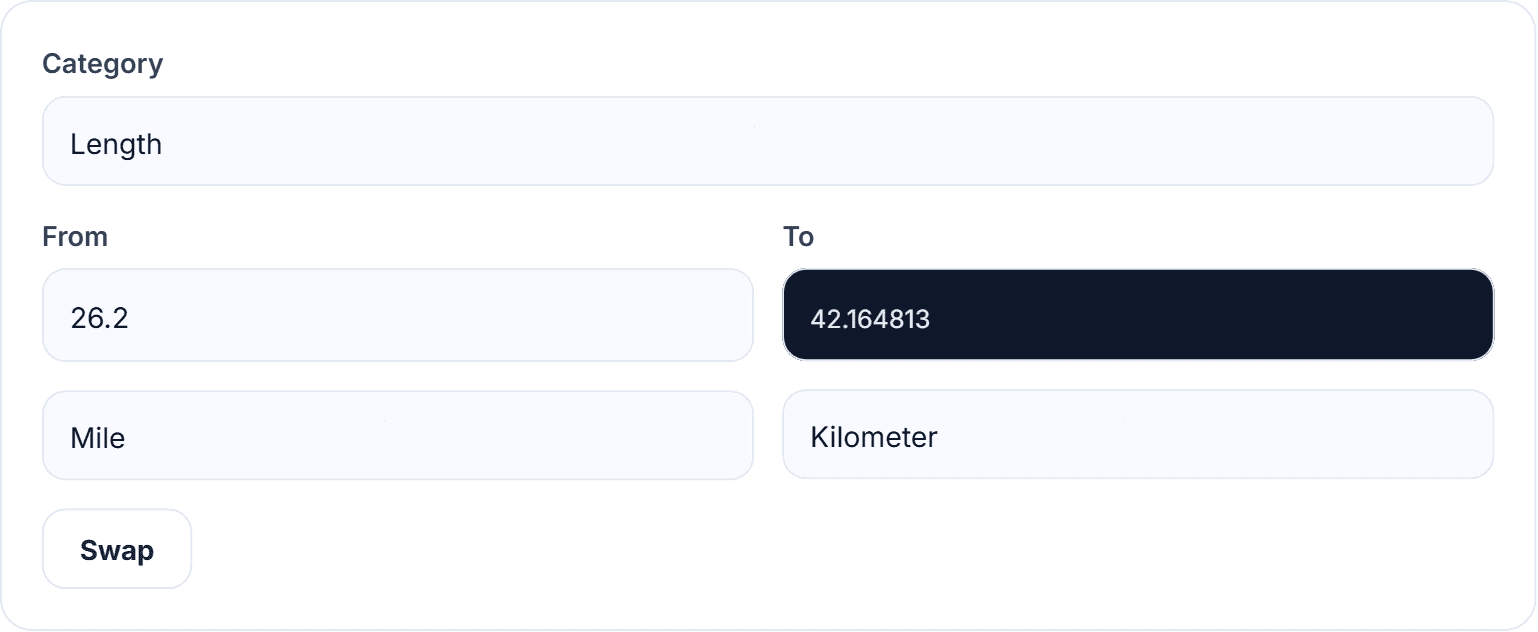
Our unit converter covers the three categories people use daily — length, weight and temperature — with the units that actually matter, converting live as you type with no submit button. One-click swap reverses direction, results use standard internationally accepted factors, and it runs entirely in your browser (it even works offline once loaded). Free, no ads chasing you down the page, no app install.
2. Google’s inline converter — great for one-offs
Typing “5kg in lbs” into Google works well for a single quick answer, but there is no swap, no working space for a series of conversions, and you need a connection.
3. UnitConverters.net — exhaustive, overwhelming
Hundreds of categories down to obscure historical units. Brilliant when you need arcminutes; slow going when you just want kg to lbs among the ad blocks.
4. ConvertUnits.com — similar breadth, similar clutter
Solid database, dated experience, heavy ads.
5. Phone converter apps
Fine offline, but most bundle ads or ask for permissions a calculator has no business requesting. A browser tool needs no install.
Why choose our converter
- Live conversion as you type — change the number, the answer changes. No button, no reload.
- Curated, not cluttered: the everyday units front and centre instead of 400 categories.
- Correct factors: standard definitions (2.54 cm to the inch exactly), and proper offset handling for temperature — the one conversion most people fumble.
- Private and light: no tracking, no upload, loads in under a second on mobile data.
How to use the unit converter
- Open the unit converter.
- Pick a category: Length, Weight or Temperature.
- Type your value and choose from/to units — the result appears as you type.
- Hit Swap to reverse direction instantly (great for double-checking).
Pro tips: for recipes, convert the oven temperature first — everything else survives approximation, baking temperatures do not; for height, remember feet come with inches (5.9 feet is not 5’9″!) — convert cm to total inches, then divide by 12; and for shipping, always convert to the courier’s billing unit before you pay, not after.
Conversion questions that catch people out
How do I convert Celsius to Fahrenheit in my head?
Double the Celsius and add 30 for a quick estimate (20°C → ~70°F). Use the tool when precision matters — the real formula is ×9/5 + 32.
How many cm is 5 feet 6 inches?
5’6″ = 66 inches × 2.54 = 167.64 cm. The converter does the two-step for you.
Is a US gallon the same as a UK gallon?
No — a US gallon is 3.785 litres, an imperial gallon 4.546 litres. Always check which one a source means.
Does the converter work offline?
Yes — once the page has loaded, conversions run locally with no connection needed.
Converting without the slips
Unit conversion is invisible until it burns your dinner or your budget. Keep the free unit converter a tap away, and while you are in the toolbox, the age calculator handles the date maths and the image compressor handles the uploads — all part of our free daily tools, with SEO tools alongside if you build websites too.