
Days Between Dates and the Off-by-One Trap
Why Monday to Friday is both 4 and 5 days, how visa day-counting really works, calendar vs working days, and the calculator that answers all of it instantly.


“Your visa allows a stay of 90 days.” “Payment due within 30 days of invoice.” “Return accepted within 14 days of delivery.” “Notice period: 60 days.” Adult life is a series of countdowns — and miscounting one can cost a visa overstay fine, a lost deposit, a missed refund window, or a contract breach.
Counting days sounds trivial until you actually try: months have four different lengths, leap years exist, weekends do not count for some deadlines but count for others, and the eternal question of whether “day one” is the start date itself trips up lawyers, let alone the rest of us. This guide covers how date counting really works, the off-by-one trap, working days, and the fastest way to get any date calculation right.
Days Between Dates
Count the days, weeks and months between any two dates.
The off-by-one trap (read this before any deadline)
Monday to Friday: is that four days or five? It depends on what you are counting — and this ambiguity is the single biggest source of date errors.
- Elapsed days (what calculators count): full days between the two dates. Monday → Friday = 4 days. This is how ages, durations and gaps work.
- Inclusive days (what many rules mean): both endpoints counted. Monday → Friday = 5 days. Hotel “3 days 2 nights”, prescription courses, and many visa rules count this way.
The 90-day visa is the famous case: most immigration authorities count the entry day as day 1 — inclusive counting. Arrive January 1 and your 90th day is March 31, not April 1. People have been fined for exactly this one-day misunderstanding. Rule of thumb: for anything legal or official, compute elapsed days with a calculator, then check whether the rule counts the first day — and when unsure, assume it does and leave a day’s margin.
Calendar days vs working days
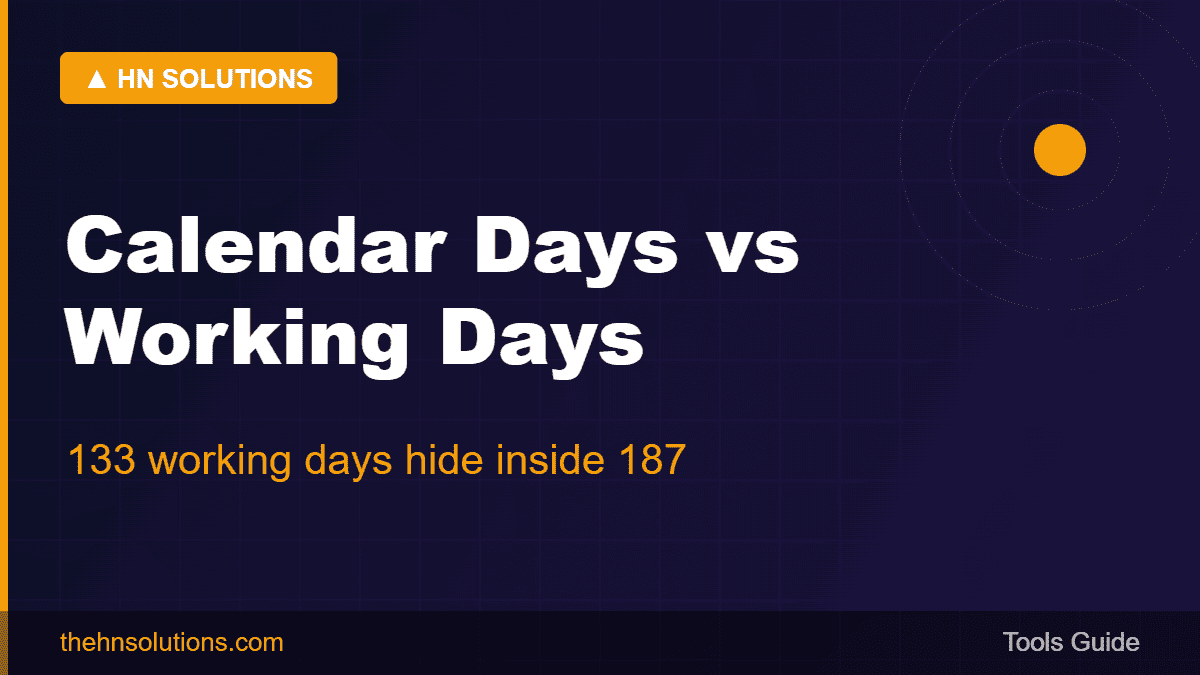
Contracts and government processes often specify working days (also “business days”) — Monday to Friday, excluding weekends. The difference is dramatic: January 1 to July 7 is 187 calendar days but only 133 working days. A “10 working day” processing time is two full weeks, not ten days.
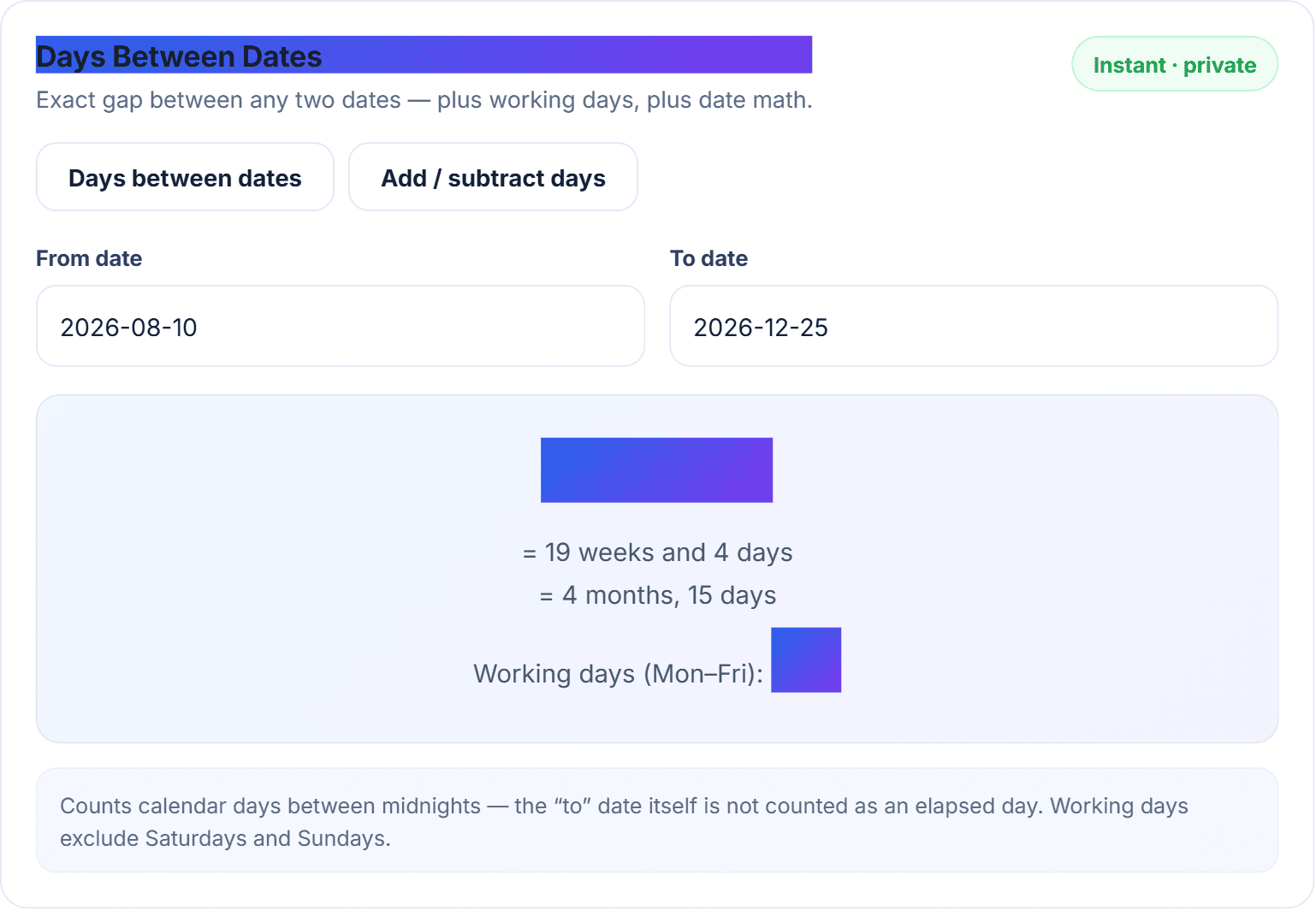
Our days between dates calculator shows both automatically — total days, plus the Mon–Fri working day count. One caveat no tool can fully solve: public holidays vary by country and year, so subtract your local ones from the working-day figure for precision.
Where date math runs your life
- Visas and immigration: stay limits, “180 days in any 365” rules, passport validity windows (“must be valid 6 months beyond departure”).
- Money: invoice terms (Net 30), credit card grace periods, refund windows, fixed deposit maturities, loan tenures.
- Work: notice periods, probation ends, project timelines, sprint planning, leave balances.
- Legal: appeal windows, statute limitations, cooling-off periods — where inclusive-vs-elapsed genuinely decides cases.
- Life: pregnancy weeks, wedding countdowns, anniversary planning, exam prep runway, subscription renewals.
The other direction: what date is N days away?

Half of date questions run forward: I got the invoice today — when exactly is Net 30? My notice period is 60 days — what is my last working day? The refund window is 14 days — when does it close?
Counting forward on a wall calendar across month boundaries (31? 30? 28?) is exactly the kind of arithmetic humans fumble. The calculator’s Add / subtract days mode answers it instantly and — usefully — tells you the weekday. “90 days from today” landing on a Sunday matters when the office is closed; many rules roll deadlines to the next business day, but never bet on it.
The best date calculators compared
1. HN Solutions Days Between Dates — best complete answer
Our calculator gives the exact day count plus every useful translation: weeks-and-days, months-and-days, and the working-day count most tools skip. Flip the mode for date-plus-N-days with the weekday named. Handles swapped dates gracefully, counts leap years correctly, works instantly on any phone, nothing stored.
2. TimeAndDate.com — the veteran, ad-heavy
Comprehensive date tools including holiday-aware business day calculators for specific countries. Powerful; buried in ads and old-web navigation.
3. Phone calendar counting — error-prone past one month
Fine for “next Tuesday”, dangerous for “90 days from March 3” — month lengths ambush finger-counting every time.
4. Spreadsheet date arithmetic — great in bulk
Excel’s date subtraction and NETWORKDAYS are excellent for project plans; overkill for a single deadline.
How to use the calculator
- Open days between dates — today is pre-filled as the end date, so “days since X” takes one input.
- Pick both dates: total days, weeks, months and working days appear instantly.
- For deadlines, switch to Add / subtract days: start date + N days → exact date and weekday.
Pro tips: for official deadlines, compute the date, then subtract one safety day — postal delays and timezone cutoffs are real; for visas, count from the entry stamp inclusively unless the rules explicitly say otherwise; and for recurring deadlines (rent, invoices), the weekday matters as much as the date — a due date on a bank holiday is a bounced payment waiting to happen.
Date-maths questions people ask
How many days between two dates inclusive?
Take the calculator’s result and add 1. Elapsed Monday→Friday is 4; inclusive is 5. Know which one your rule means.
How are months counted between dates?
Calendar-aware: March 15 → June 10 is 2 months 26 days, borrowing real month lengths — the same logic as our age calculator.
Do leap years affect the count?
Yes, and the calculator handles them — spans crossing February 29 include it as a real day.
Can I count working days excluding my country’s holidays?
The tool excludes weekends automatically; subtract your national holidays from the working-day figure manually — holiday calendars differ by country, region and year.
Getting deadline maths right
Every deadline is a date calculation, and every date calculation has an off-by-one ambush waiting. Let the free calculator do the counting — then check the inclusive rule and add a margin day. Related maths lives nearby: the age calculator for exact ages, the percentage calculator for the interest on that Net-30 invoice, all in our free daily tools.