
Text Case: Title Case, camelCase and snake_case
The actual rules of Title Case, why big publications switched to sentence case, where each developer case belongs, and the one-click fix for any case disaster.

You typed a whole paragraph before noticing Caps Lock was on. Your blog title looks amateur because “Of” and “The” are capitalized mid-sentence. Your code review got rejected because the variable was user_name in a camelCase codebase. Three tiny problems, one shared theme: text case has rules, and everyone is expected to know them without ever being taught.
This guide actually teaches them — the publishing conventions behind Title Case, when headlines use sentence case instead (most big publications switched, and there is a reason), the developer cases and where each belongs, and the converter that fixes any of it in one click, live as you type.
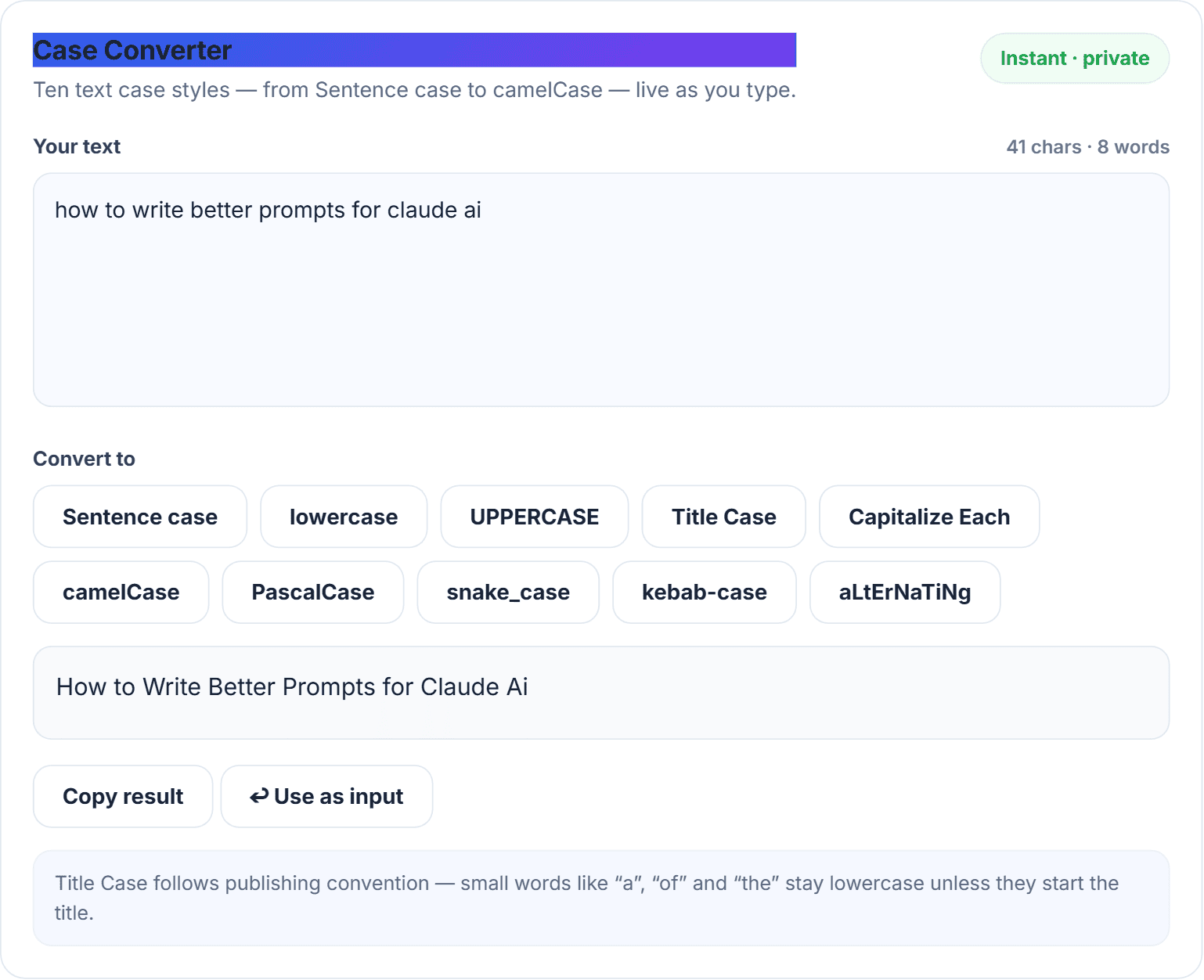
Case Converter
Switch text between UPPER, lower, Title and Sentence case.
The everyday cases
Sentence case — the default of civilisation
First letter capitalized, everything else lowercase except proper nouns. It is how this paragraph works, how most modern headlines work, and the fix for every Caps Lock accident. If in doubt anywhere, sentence case is never wrong.
Title Case — the formal headline
Major words capitalized, minor words lowercase: “The Quick Brown Fox of the Forest”. The rule everyone half-remembers: articles (a, an, the), short conjunctions (and, or, but) and short prepositions (of, in, to, on) stay lowercase — unless they are the first or last word. Style guides fight over the details (AP capitalizes 4+ letter prepositions, Chicago does not) but that core covers 95% of cases. Our case converter‘s Title Case follows these publishing rules — unlike naive tools that capitalize Every Single Word and make titles look like 2009 spam.
UPPERCASE and lowercase — the shouters and whisperers
Uppercase for legal headers, acronym prep and labels — never for body text, where it reads as yelling and measurably slows reading. All-lowercase became an aesthetic (brands, poets, tired people on the internet); it also hides inside data-cleaning pipelines, where normalising case before comparison is step one.
Capitalize Each Word — the imposter
Every word capitalized regardless of importance. People reach for it thinking it is Title Case; publications never use it. Know the difference and your headlines quietly level up.
Why big publications abandoned Title Case
Look at BBC, Guardian, or most tech blogs: sentence case headlines. Research and readability testing kept showing sentence case is faster to scan and feels more conversational, while Title Case reads as more formal and traditional — which is why The New York Times keeps it. For your own blog: pick one, apply it everywhere, and let consistency do the professionalism. (Whichever you pick, our AI title generator writes headlines and the converter formats them.)
The developer cases

Programming languages cannot abide spaces in names, so conventions evolved — and each ecosystem picked a favourite:
- camelCase — first word lowercase, subsequent words capitalized:
userLoginCount. The JavaScript and Java standard for variables and functions. - PascalCase — every word capitalized:
UserLoginCount. Classes and components — every React component you have ever seen. - snake_case — lowercase with underscores:
user_login_count. Python’s house style, plus databases and Rust. - kebab-case — lowercase with hyphens:
user-login-count. URLs (Google treats hyphens as word separators — underscores, not reliably), CSS classes, file names. Every slug on this site is kebab-case for exactly that SEO reason.
Converting a phrase like “user login count” between these by hand is trivial once and soul-crushing forty times. The converter strips punctuation, splits words and joins them in whichever convention you click — including round-trips between conventions when refactoring across languages.
The best case tools compared
1. HN Solutions Case Converter — best coverage, live
Our case converter does ten styles — the five everyday cases plus camelCase, PascalCase, snake_case, kebab-case and aLtErNaTiNg (for when the group chat requires sarcasm). Output re-converts live as you keep editing the input, with word and character counts, one-click copy and a use-as-input button for chaining. Free, private, no limits.
2. Convert Case (convertcase.net) — the veteran
Long-running and solid for the basics; developer cases and publishing-correct Title Case are thinner, and the ads are not.
3. Word / Google Docs Format menu — fine inside the doc
Shift+F3 in Word cycles three cases; Docs hides more under Format → Text. Handles neither developer cases nor proper Title Case rules.
4. Editor extensions and IDE actions — best mid-code
VS Code commands and multi-cursor tricks convert cases without leaving the editor — right answer during coding, unavailable everywhere else you write.
How to use the case converter
- Open the case converter and paste or type your text — counts appear immediately.
- Click a style. The result appears below and keeps updating live as you edit the input — pick once, keep typing.
- Copy the result, or press “use as input” to chain (e.g., fix Caps Lock damage with Sentence case, then Title Case the result for a headline).
Pro tips: Caps Lock disasters → Sentence case restores capitals after full stops automatically; headlines → run Title Case, then manually capitalize any proper nouns the rules cannot know about; slugs and filenames → kebab-case, always, for both Google and future-you; and check your final headline length in the word counter — under 60 characters if it is going in a title tag (the meta tag generator will confirm).
Common questions about text case
Which words stay lowercase in Title Case?
Articles (a, an, the), short conjunctions (and, but, or, nor) and short prepositions (of, in, on, at, to, by) — except as the first or last word of the title. Our converter applies this automatically.
Should my blog titles use Title Case or sentence case?
Either — consistently. Title Case reads formal/traditional, sentence case reads modern/conversational. Most new blogs pick sentence case; whichever you choose, never mix.
Why kebab-case for URLs?
Google explicitly treats hyphens as word separators in URLs; underscores historically were not. my-best-post beats my_best_post for search clarity.
Does the converter handle punctuation and numbers?
Everyday cases preserve them; developer cases strip punctuation and join clean words with numbers kept — which is what a valid identifier needs.
Picking a case and sticking to it
Case conventions are tiny signals of craft — headlines that follow the rules, code that matches the house style, slugs that Google parses cleanly. The free case converter handles all ten in a click; pair it with the title generator for what the headline says, the grammar checker for the text around it, and the rest of the free daily tools for everything else.
Free tools for this
Built here, run in your browser, no sign-up.