
BMI Explained: What It Means and When It Lies
What BMI actually measures, the WHO ranges, where the number misleads athletes and older adults, and how to use it as a smoke detector rather than a verdict.

Type your height and weight into any BMI calculator and a number comes back — 22.5, or 27.8, or 31.2 — followed by a one-word judgement of your body. It feels authoritative. It is printed on medical forms, used by insurers, quoted by gym trainers and argued about endlessly online.
Here is what almost nobody explains: what that number actually measures, why a 19th-century Belgian mathematician invented it for populations rather than people, when it genuinely matters for your health, and when it is flatly wrong about you. This guide covers all of it — plus how to get your BMI, your category, and the healthy weight range for your exact height in about four seconds.
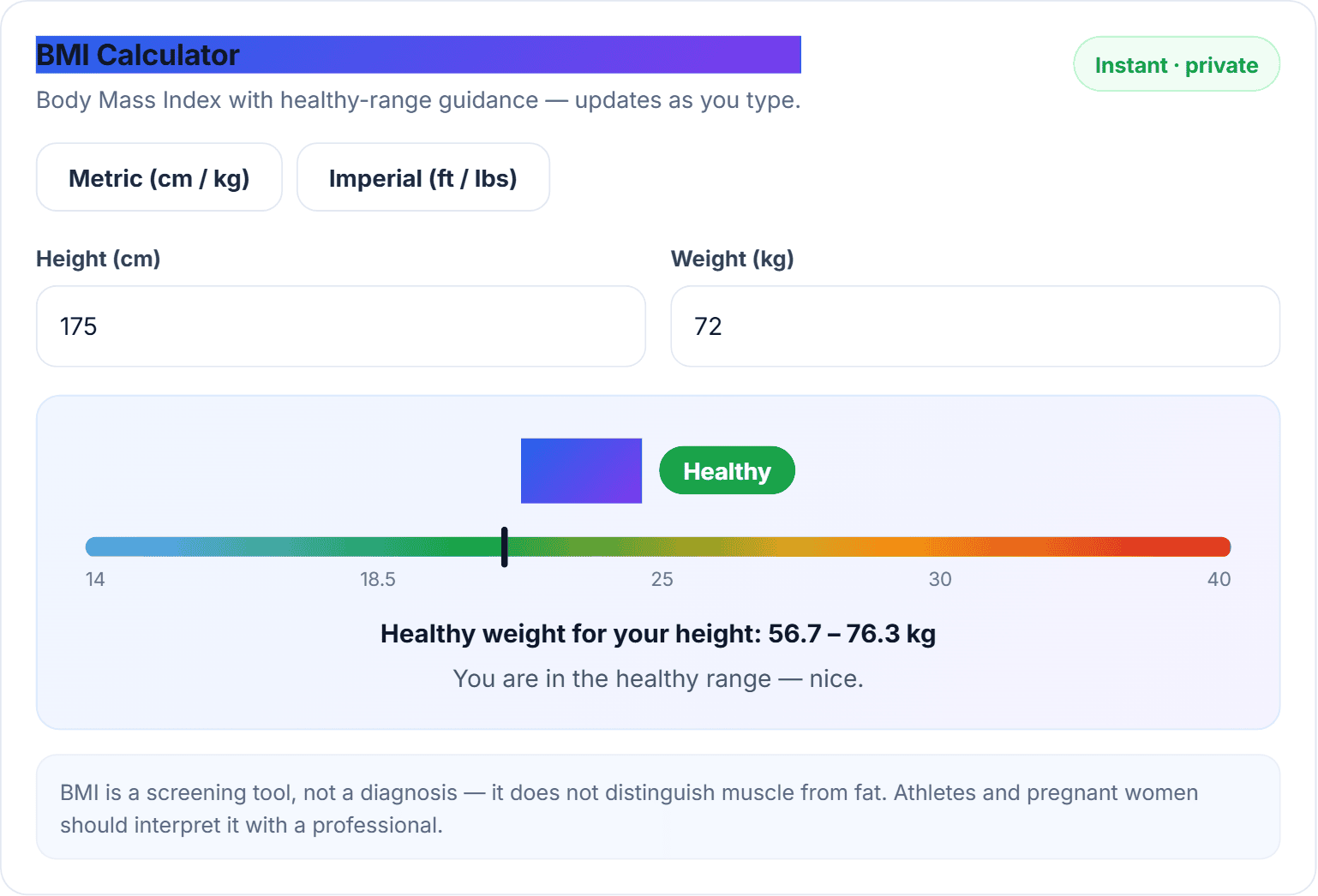
BMI Calculator
Body mass index from height and weight, metric or imperial.
What BMI actually is
Body Mass Index is weight divided by height squared — kg/m², or 703 × pounds ÷ inches² in imperial. Adolphe Quetelet devised it in the 1830s to describe the “average man” across populations, and it stuck because it needs only a scale and a tape measure: no lab, no calipers, no cost.
The World Health Organization’s adult bands are the ones your doctor uses:
- Under 18.5 — Underweight. Associated with nutritional deficiency, bone density loss and immune weakness.
- 18.5 to 24.9 — Healthy range. Statistically the band with lowest risk for the big lifestyle diseases.
- 25 to 29.9 — Overweight. Elevated risk begins here, gradually.
- 30 and above — Obese. Substantially higher risk of type 2 diabetes, heart disease, joint problems and more.

Why BMI is still used everywhere
Because at population scale it works. Across millions of people, BMI correlates strongly with body fat and with health outcomes — it is the cheapest early-warning signal medicine has. Doctors use it as a screening step: a flag that says “look closer”, not a diagnosis. Insurance actuaries, public health researchers and epidemiologists rely on it because it is consistent, comparable and free.
The problems start when a population statistic gets applied to an individual as if it were a verdict.
Where BMI gets it wrong about individuals
- Muscle reads as fat. BMI cannot tell them apart. Rugby players, lifters and sprinters routinely score “overweight” or “obese” while carrying less body fat than their “healthy BMI” neighbours. If you train seriously, expect your number to read high and care less.
- Age changes the picture. Older adults lose muscle; a “healthy” BMI can mask low muscle and higher fat. Some geriatric research actually finds slightly higher BMI protective in the elderly.
- It says nothing about fat location. Visceral fat around the organs drives most metabolic risk — and someone with a normal BMI can carry plenty of it. Waist circumference catches what BMI misses.
- Ethnic thresholds differ. Risk begins at lower BMIs for many South Asian populations — several health services use 23 rather than 25 as the overweight line.
- It was never meant for pregnancy, children, or athletes. Children use age-adjusted percentile charts entirely.
How to actually use your BMI
Treat it like a smoke detector: cheap, always on, occasionally false-alarming, and worth investigating when it goes off. The productive way to use our BMI calculator:
- Get your number and range. The calculator shows your BMI on a colour gauge, your WHO category, and — the genuinely useful part — the healthy weight range for your exact height, plus how far you are from it.
- Track the trend, not the snapshot. A single reading means little; the direction over months means a lot. Same time of day, same conditions, monthly is plenty.
- Pair it with a tape measure. Waist-to-height is the simplest upgrade: keep your waist under half your height and you have covered BMI’s biggest blind spot.
- Let it prompt a conversation, not a panic. Persistently outside the range in either direction? That is a doctor conversation, where BMI will be one number among many.
The best BMI tools compared
1. HN Solutions BMI Calculator — best instant, complete answer
Our BMI calculator works in metric and imperial, updates live as you type (no submit button), plots your result on a colour gauge, and gives you what most calculators skip: the healthy weight range for your specific height and the exact distance to it. No ads between you and the number, nothing stored, works on any phone.
2. NHS / CDC calculators — authoritative, form-like
The official health-service calculators are accurate and well-caveated, wrapped in multi-step forms and follow-up questionnaires. Great references, slower answers.
3. Smart scales — automatic tracking, noisy data
Scales that estimate body fat via bioimpedance track trends automatically but their fat estimates swing with hydration. Fine for trends, dubious for absolutes.
4. Fitness apps — BMI plus everything else
MyFitnessPal and friends calculate BMI inside broader tracking. Useful if you want the whole ecosystem; heavy if you want one number.
What people ask about BMI
What is a good BMI for my height?
The healthy band is 18.5–24.9 for most adults — but the useful version of that answer is in kilograms: our calculator converts the band into an actual weight range for your height, which is the number you can act on.
Should I aim for the middle of the range?
No target inside the healthy band beats another. Habits — sleep, movement, food quality, not smoking — beat decimal chasing every time.
Is BMI different for men and women?
The standard bands are identical, despite body-composition differences — one more reason it is a screening tool rather than gospel.
My BMI says overweight but I lift weights. Should I care?
Probably not much. Check your waist-to-height ratio and how clothes fit; muscle mass sends BMI up while sending actual risk down.
Using BMI sensibly
BMI is a fast, free, imperfect first look at one dimension of health. Get yours — with the range and context that make it useful — from the free BMI calculator, and while numbers are on your mind, the percentage calculator handles the “what percent did I lose” maths and the age calculator the rest. All part of our free daily tools.